Avoid your inquiry is delay response, please enter your WhatsApp/Skype along with the message, so we can contact you at the very first time.
We will reply you within 24 hours. If for urgent case, please add WhatsApp/WeChat: +8615063007107,. Or call 0086-15063007107 directly.
You need stone that performs, looks great, and lasts. But geology terms get confusing—crystal, mineral, igneous rock. If you pick the wrong granite, budgets suffer. Here’s a clear, builder-friendly guide to help you choose with confidence, backed by manufacturing know-how.
Granite is not a single crystal. Granite is a rock—specifically an igneous rock—that’s composed of various minerals, mainly quartz, feldspar, and mica. Each mineral crystallizes as magma begins to cool deep underground, creating the familiar coarse-grained look you see on slabs and pavers.

Is Granite a Crystal or an Igneous Rock
A mineral is a naturally occurring crystalline substance with a specific chemical formula—quartz (SiO₂), plagioclase feldspar, potassium feldspar, muscovite, biotite, or amphibole are examples. Granite is a rock composed of these various minerals. That difference makes granite a multi-component material: a rock, not a single mineral or a lone crystal.
You’ll often hear, “Quartz are classified as silicate minerals.” While the grammar is clunky, the idea is right—quartz belongs to the silicate family that gives granite its sparkle, hardness, and weather resistance. In other words, what makes granite perform is the mix of hard, interlocking individual crystals formed as magma cools.
Deep in the continental crust, molten rock (molten magma) intrudes into rock layers and slowly cools over millions of years. As it cools, crystals form—first plagioclase and potassium feldspar, then quartz, with flakes of biotite or muscovite and prismatic amphibole. The result is a coarse-grained texture of granite with large crystals you can see by eye.
As the pluton hardens and the resulting rock is uplifted, erosion can remove overburden and bring granite onto the surface—it reaches the surface where we quarry it as dimension stone. That slow cool and solidify sequence is why granite is formed with strength and beauty for structural and finishing work.
Most granites contain 20–60% quartz (the percentage of quartz helps classify the rock), lots of plagioclase feldspar, some potassium feldspar, plus lesser mica and amphibole. The interaction of quartz and feldspar sets overall tone and hardness; flecks of mica add sheen; dark biotite patches add contrast.
Color trends follow the minerals present. Pinkish tones come from potassium-rich feldspar; gray/white matrices highlight quartz; darker looks reflect biotite and amphibole. This mix makes granite desirable for plazas, stairs, façades, and granite countertops—where the appearance of granite really matters.
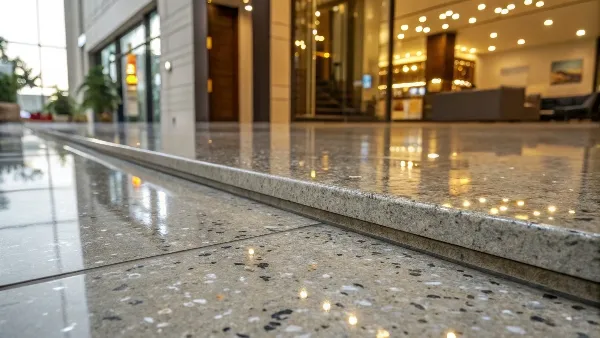
Which minerals in granite give granite its look?
Yes. Granite is an igneous rock formed underground. In fact, it’s an intrusive igneous rock composed mostly of quartz and feldspar. Because it forms slowly below the surface, it has that distinct coarse-grained texture and high durability contractors count on. In specs, you may see it simply described as an intrusive rock used for load-bearing and cladding.
A rock called quartzite is actually a rock composed mostly of quartz; it’s very hard, but different from granite. When choosing a rock type, match porosity, compressive strength, finish, and maintenance to the use case. For pool decks and plazas, granite is a common rock choice for longevity.
Quick comparison table
|
Property |
Granite (igneous rock) |
Marble (metamorphic) |
Limestone (sedimentary) |
|
Main minerals |
Quartz, plagioclase feldspar, mica |
Calcite/dolomite |
Calcite |
|
Porosity |
Low |
Medium |
Medium–High |
|
Best for |
Plazas, cladding, steps, granite countertop |
Interiors, feature walls |
Landscaping, façades (protected) |
|
Weathering |
Excellent |
Good (can etch) |
Good (needs sealing) |
As a granitic rock, granite stone is tough: interlocking crystals resist abrasion and freeze-thaw. That’s why granite is a popular dimension stone for bridges, kerbs, transit hubs—and granite countertop installations in high-use kitchens. In many city specifications, granite used for treads and plazas outperforms alternatives over decades.
Practical note: A high content of silica and alkali metal oxides in feldspar help with hardness and weather resistance. Combined with low porosity, granite contains what projects need for stain and scratch performance in real-world conditions.
Because granite occurs with different minerals in granite, specifying finish matters: flamed, honed, or polished shift light behavior. Finishes can make grains small to see at distance, or highlight the crystalline matrix up close for premium spaces.
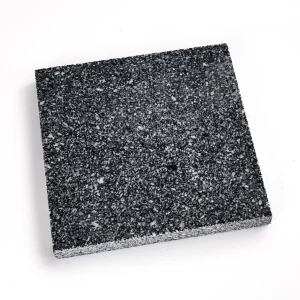
black granite
Quarried from basement rock bodies in the continental crust, granite makes robust pavers, steps, bollards, benches, and cladding. Memorial parks commission granite memorials for permanence, while civic architects choose natural stones like granite for plazas that must endure generations.
Because granite is formed deep underground, then uplifted and exposed by erosion, it’s abundant across many regions. That abundance of granite means stable supply and cost control—key for multi-phase developments and long-term maintenance planning.
We process large granite blocks into granite slab and calibrated tiles, delivering consistent thickness and finish. Choose polished granite for lobbies, flamed for anti-slip plazas, and honed/sandblasted for balanced traction and aesthetics. The texture of granite and finish selection shape both look and performance.
For project teams, we provide shop drawings and customized edge details. As a professional stone manufacturer and supplier, we support bulk schedules, color matching across phases, and tight tolerances—so the resulting rock products drop into place on site.
Helpful internal resources
Explore real-world colors and finishes:
In hand specimen, granite is an igneous rock with visible grains: light feldspar and quartz plus darker biotite/amphibole. The appearance of granite is speckled due to individual crystals that grew as molten material began cooling and solidifying.
A quick job-site heuristic: If grains are too small to see, you might have a volcanic rock (rapid cooling at the surface). If it’s sugary white and fizzes with acid, you’re probably holding limestone. If it’s banded or veined from heat/pressure, think metamorphic rocks such as gneiss or marble.
Technically, classification hinges on the percentage of quartz and feldspar proportions. Typical granite includes 20–60% quartz, with the balance mainly plagioclase feldspar and potassium feldspar—plus accessory mica and amphibole. An igneous rock composed of much less quartz might be diorite, not granite.
A textbook definition: granite is a rock that is an intrusive igneous rock composed mostly of quartz and feldspar, with a high content of silica and certain alkali metal oxides. The country rock around the intrusion influences chemistry; as magma interacts and cools slowly, the resulting rock acquires its signature properties.
Is granite a crystal?
No. Granite is a rock made of various minerals. Each mineral is a crystal, but the whole rock is not a single crystal.
What minerals are found in granite?
Commonly quartz, plagioclase, potassium feldspar, biotite, muscovite, and amphibole. The balance of minerals in granite shapes color and performance.
How is granite formed underground?
Granite forms when molten magma intrudes deep below the surface, then cools slowly. As the magma cools, crystals form and interlock into a strong matrix. The uplifted rock called a pluton can then be quarried.
What’s the typical percentage of quartz in granite?
Industry references often cite 20–60% quartz by volume (context and classification diagrams vary among sources). This range helps separate granite from related rock type families.
Where is granite used most effectively?
Transit plazas, stairs, kerbs, façades, memorials, and interior flooring. Granite is used wherever long service life and low maintenance matter.
Is all black “granite” actually granite?
Trade names vary. Some “black granite” products can be gabbro or basalt. Always review petrographic data or ask your granite supplier for test reports.
A metro authority required slip-resistant pavers, curb stones, and tactile bands for a high-traffic plaza. We supplied calibrated flamed granite with consistent grain. After five winters, inspectors reported minimal wear and excellent traction. That’s the practical value of an intrusive rock with interlocking crystals and low porosity.
As a professional stone manufacturer and supplier, we source from proven quarries and control slab yields, minimizing shade variation across phases. We coordinate blocks from the same bench so your Phase 2 matches Phase 1—critical for civic squares and malls.
We handle shop drawings, edge profiling, and packaging, then load containers with secure blocking. For long-haul jobs, our logistics team sequences shipments so the right crates arrive just-in-time for installation.
“Granite is a widely occurring intrusive rock of felsic composition, typically containing quartz and feldspar, with other minerals present in minor amounts.”
Key phrases to remember

 English
  French
  German
  Russian
  Arabic
