Avoid your inquiry is delay response, please enter your WhatsApp/Skype along with the message, so we can contact you at the very first time.
We will reply you within 24 hours. If for urgent case, please add WhatsApp/WeChat: +8615063007107,. Or call 0086-15063007107 directly.
Choosing the wrong stone can lead to stains, chips, delays, and costly replacement. These risks grow on large projects where one material problem affects hundreds of units. Granite offers a strong solution because it combines durability, natural beauty, fabrication flexibility, and broad construction use.
Granite is useful because it is hard, durable, heat resistant, visually distinctive, and suitable for both indoor and outdoor projects. Granite countertops can handle daily kitchen use, while thicker stone products serve floors, walls, stairs, paving, curbs, and landscaping. Proper selection, fabrication, sealing, and installation help granite deliver long-term performance.

Why Is Granite So Useful? Pros and Cons of Granite Countertops vs Quartz and Marble
This guide explains:
Granite is a coarse-grained igneous rock. It forms when molten rock slowly cools and solidifies underground. Because the cooling process takes place deep beneath the earth’s surface, mineral crystals have time to grow and interlock.
The main minerals in natural granite are usually quartz and feldspar, together with smaller amounts of mica, amphibole, and other minerals. The exact mineral mix changes from one quarry to another. This variation creates the different colors, grains, veins, dots, and crystal patterns seen across granites from different regions.
The U.S. Geological Survey explains that granitic rocks form when magma cools slowly underground. It also identifies quartz, potassium feldspar, and plagioclase feldspar as common light-colored minerals in granite.
This natural production process gives each granite slab its own appearance. Two slabs from the same block may look similar, but they will not be perfectly identical. For architects and developers, that natural variation can create a more distinctive result than a fully uniform artificial product.
As a professional stone manufacturer and supplier, we often help buyers select the right natural granite slabs for commercial and residential projects according to color, grain, thickness, surface finish, and application.
Granite’s strength comes from its dense, interlocking mineral structure. Quartz and feldspar form much of the rock, while other minerals influence color, texture, and performance.
People sometimes say that granite is 7 on the Mohs hardness scale. That description is too simple because granite is a rock made from several minerals rather than one mineral with one fixed hardness value.
Quartz has a hardness of 7 on the Mohs hardness scale, while common feldspar minerals are generally around 6 to 6.5. Because these hard minerals make up a large part of granite, a finished granite surface resists ordinary scratching and abrasion well.
This hardness is one of the main reasons why granite works well for:
Still, hardness does not make granite impossible to damage. A heavy impact on an unsupported edge may cause it to crack or chip. Thin areas around sinks, cooktops, or faucet holes need correct fabrication and support.
The fabricator must also understand the grain, fissures, and natural structure of the type of granite being processed. Good material can still fail when cutting, transportation, installation, or structural support is poor.
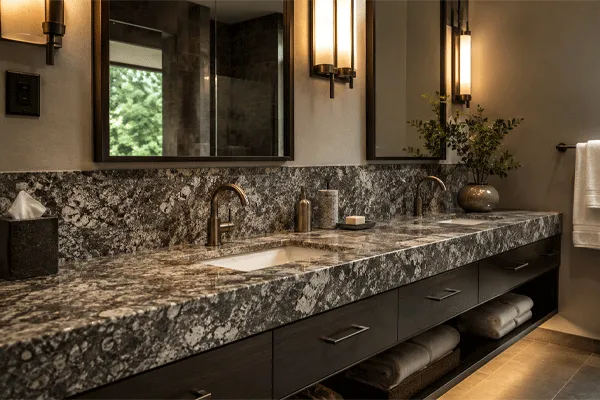
Granite is a popular kitchen countertop material because it balances practical performance with natural appearance. It can withstand normal food preparation, repeated cleaning, kitchen tools, and daily contact better than many soft decorative materials.
Each granite countertop also looks unique. The color and pattern come from natural mineral formation rather than a printed surface. Buyers can choose from subtle white and gray materials, deep black granites, warm brown colors, red tones, green stone, blue-toned materials, and highly active patterns.
The main reasons why granite remains popular include:
The Natural Stone Institute describes granite as a durable building stone and reports typical heat resistance up to about 250°C or 480°F. However, the institute also discourages placing concentrated heat directly on the stone because rapid temperature differences may cause cracking.
A homeowner may place a warm pan on granite without immediate damage, but using a trivet under hot pots and pans remains the safer practice.
The pros of granite countertops go beyond their appearance. A suitable slab can provide strong functional value in homes, hotels, apartments, restaurants, offices, and other commercial spaces.
Granite has good resistance to scratching, normal impact, and everyday wear. This durability makes it suitable for high-use areas where weaker surfaces may show damage quickly.
Granite is a natural material. No two pieces of granite have exactly the same mineral structure. This helps designers create a surface that does not look mass-produced.
A granite surface handles normal kitchen heat well. It is still wise to use mats or trivets because severe thermal shock can damage natural stone.
Granite can receive different finishes, including:
A polished finish is common for kitchen countertops. Flamed or bush-hammered finishes offer more texture for outdoor paving, stairs, and wet areas.
A granite slab can be cut and polish processed into many shapes. It can support straight edges, eased edges, beveled edges, laminated edges, drainage grooves, backsplash strips, and undermount sink openings.
Well-selected natural stone may add value to your home or improve the market position of a commercial property. It cannot guarantee a fixed increase in a home’s value, but durable stone surfaces can strengthen the overall quality impression.
For projects requiring cut-to-size pieces, edge work, sink openings, or matching panels, our custom granite countertop fabrication services can support drawings, sample confirmation, quality control, and bulk production.
Why Is Granite So Useful? Pros and Cons of Granite Countertops vs Quartz and Marble
A useful buying guide should explain both the pros and cons of granite. No countertop surface is perfect for every budget, design, or installation.
A small sample cannot show the full appearance of a large granite slab. Veins, mineral clusters, shade changes, and natural features may appear across the finished surface.
For large projects, buyers should approve full-slab photos, production samples, or an acceptable variation range before cutting begins.
Granite is relatively dense, but it is not always completely non-porous. Absorption varies by stone type. Some materials resist liquids well, while others may absorb oil or colored liquid more easily.
The Natural Stone Institute states that it often makes sense to seal marble and granite countertops with a quality impregnating sealer. The need for sealing depends on the stone and its absorption characteristics.
Large kitchen islands or long commercial counters may require more than one slab. Skilled planning can reduce the visual impact of seams, but it cannot always remove them.
Cabinets, bases, floors, anchors, and transport systems must support the material. Poor handling can damage the slab or create a safety risk.
The main countertop surface is hard, but exposed edges and corners can chip under a strong impact. Edge profile and support design affect this risk.
Small chips can often be repaired with color-matched resin. However, the repaired area may not perfectly match the natural minerals.
These cons of granite countertops do not make granite a poor choice. They show why material inspection, professional fabrication, packaging, and installation matter.
Quartz countertops and natural granite often compete for the same projects, but they are different types of material.
Granite is cut from natural stone blocks. Engineered quartz is manufactured from quartz particles combined with resin, pigments, and other materials. This production process can give engineered quartz a more controlled color and pattern.
| Feature | Granite countertops | Engineered quartz countertops |
|---|---|---|
| Material type | Natural stone | Manufactured composite |
| Pattern | Naturally varied | More controlled and repeatable |
| Heat response | Generally strong heat resistance | Resin may be more sensitive to high heat |
| Porosity | Varies by granite | Usually low |
| Sealing | May be recommended | Usually not required |
| Outdoor use | Many granites perform well | UV exposure may affect some products |
| Slab consistency | Natural variation | Higher visual consistency |
| Edge repair | Possible but may remain visible | Possible, product-dependent |
| Design value | Unique natural surface | Predictable modern appearance |
Quartz may suit buyers who want consistent color across many apartment units. Granite may suit projects where natural variation, outdoor performance, and stone character are important.
A quartz countertop is often described as non-porous because its resin-bound structure has very low absorption. Natural granite should not automatically receive the same description. Some dense granites have very low absorption, but the exact result depends on the material.
For buyers comparing materials for multi-unit developments, our granite and engineered quartz surface options can be evaluated according to project quantity, color consistency, heat exposure, outdoor use, and maintenance requirements.
Granite and marble are both premium natural stone materials, but they have different properties and design effects.
Marble is valued for its flowing veins, soft visual depth, and classic appearance. It is widely used for bathrooms, wall panels, hotel interiors, fireplace surrounds, floors, and luxury decorative features.
Granite is usually harder and more resistant to scratching than marble. It is often a better choice for busy kitchen surfaces, outdoor steps, paving, transportation areas, and commercial locations with higher wear.
| Feature | Granite | Marble |
|---|---|---|
| Geological type | Igneous rock | Metamorphic rock |
| Typical appearance | Grain, crystals, mineral movement | Veins and softer movement |
| Scratch resistance | Generally higher | Generally lower |
| Acid sensitivity | Usually lower | High; acids may etch the surface |
| Kitchen use | Common | Requires greater care |
| Exterior use | Many types are suitable | Material- and climate-dependent |
| Design character | Strong, natural, varied | Elegant, classic, decorative |
A kitchen spill containing lemon juice, vinegar, or another acid can etch many marble surfaces. Granite normally offers better resistance, although harsh chemicals should still be avoided.
Neither material is automatically superior. The right choice depends on the location, expected use, finish, cleaning process, climate, and design intent.
Buyers can compare premium marble slabs and custom marble products with granite before confirming a project specification.
Granite has strong heat resistance, but “heat resistant” does not mean completely heatproof. The stone may tolerate a hot object, while the sealer, nearby seam resin, or sudden temperature difference may respond differently.
For safer use:
Granite also has good stain resistance when the stone is dense, properly finished, and sealed when necessary. However, oil, wine, coffee, sauces, and colored liquids should not remain on the surface for long periods.
Clean a spill promptly with a soft cloth. Use a pH-neutral cleaner designed for natural stone. Avoid abrasive powders and strong acidic products.
The Natural Stone Institute recommends using trivets or mats even though many stones can withstand heat. It also explains that stone sealers act more like repellents than an absolute waterproof barrier.
| Situation | Recommended action |
|---|---|
| Water spill | Wipe with a soft cloth |
| Oil or sauce | Clean promptly with stone-safe cleaner |
| Hot pan | Use a trivet |
| Daily dust | Use a soft, clean cloth |
| Acidic cleaner | Avoid |
| Strong abrasive | Avoid |
| Water darkens the stone | Ask whether resealing is needed |
| Small edge chip | Contact a stone repair professional |
Minimal processing does not mean zero maintenance. Granite is durable, but correct care protects its finish and stain resistance.
Why Is Granite So Useful? Pros and Cons of Granite Countertops vs Quartz and Marble
The cost of granite countertops depends on far more than the name of the stone. Two materials that look similar may have very different costs because of quarry output, block quality, transport distance, slab yield, and fabrication difficulty.
The main cost factors include:
A supplier may quote material per square foot, per square meter, per slab, per crate, or per finished piece. Buyers should confirm exactly what the quotation includes.
For example, a low slab price may not include:
The type of granite you choose also changes the cutting yield. A highly directional pattern may require extra slab area so adjacent pieces can be matched. A simple, consistent granite may allow more efficient cutting.
For contractors and importers, total installed cost matters more than the lowest stone price.
The production process begins at the quarry, where large blocks are extracted from the rock deposit. The blocks are inspected, transported, and cut into slabs using large industrial equipment.
After sawing, the slab receives a surface treatment. Polished granite has a glossy finish, while honed granite has a softer matte appearance. Textured finishes may be used for exterior or slip-sensitive applications.
A typical countertop workflow includes:
The fabricator should position templates carefully around natural fissures, veins, and mineral features. Good planning also helps the pattern flow between connected countertop pieces.
An undermount sink opening requires accurate cutting and polished inner edges. Narrow stone areas around a sink or cooktop may need extra reinforcement.
For bulk projects, digital drawings, piece numbers, room numbers, and crate lists make installation easier. Our custom stone fabrication and cut-to-size production supports contractors, project developers, wholesalers, and importers that need repeated dimensions and organized delivery.
Granite is one of the most versatile construction stones. Its strength, weather resistance, available finishes, and appearance allow it to serve indoor and outdoor projects.
Polished or honed granite can be used in hotel lobbies, shopping centers, office entrances, airports, and public buildings. The finish should match the required slip resistance and traffic level.
Granite panels can protect and decorate building facades. Panel thickness, anchors, wind load, joint design, and stone testing must follow the project specification.
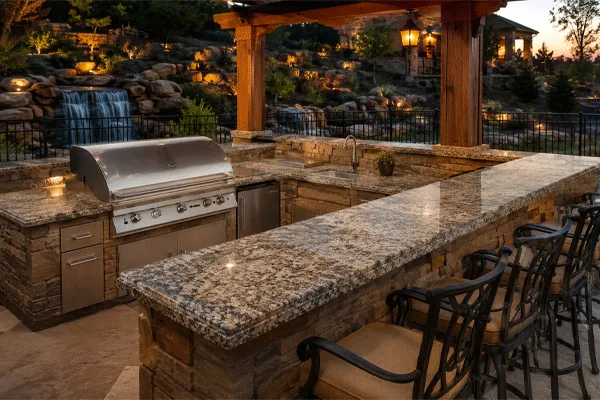
Flamed, sandblasted, or bush-hammered granite provides a textured surface for plazas, walkways, driveways, parks, and landscape projects.
Granite works well for interior and exterior stair treads. Contractors can add anti-slip grooves or textured strips where required.
Thick granite products can be used for road curbs, drainage edges, public squares, bollards, and other urban works.
Granite can also become wall cladding, reception desks, elevator surrounds, fireplace areas, columns, fountains, benches, and monuments.
This broad product range is one of the strongest reasons why granite is useful. The same stone family can support a kitchen countertop, a hotel entrance, a public plaza, and an exterior facade.
Large projects need more than a beautiful sample. Contractors and developers must consider supply continuity, variation control, testing, fabrication capacity, shipping, and replacement stock.
A large commercial project should establish an approved stone range before mass production. This may include:
Consider a commercial property development requiring lobby flooring, exterior steps, wall panels, and reception counters.
Ordering each item from a different source may create color differences, schedule conflicts, and several packaging standards. A coordinated stone supplier can review the whole project and divide the material by application:
| Area | Suggested granite product |
|---|---|
| Lobby floor | Honed or polished tiles |
| Exterior steps | Flamed treads and risers |
| Wall areas | Cut-to-size panels |
| Reception counter | Polished slabs |
| Outdoor paving | Flamed or bush-hammered pavers |
The material does not need to be identical in every area. It needs to be technically suitable and visually coordinated.
This planning reduces waste, supports faster installation, and gives the project team one clear quality-control process.
A reliable supplier should do more than show attractive slab photos. The supplier must understand quarry materials, fabrication, drawings, tolerances, packaging, inspection, logistics, and installation needs.
Before placing a bulk order, ask about:
It is also useful to request:
As a professional stone manufacturer and supplier, we support contractors, developers, importers, and wholesalers with bulk stone procurement, custom fabrication, project scheduling, quality inspection, technical communication, and export coordination.
Our work begins with your drawings and project requirements. We then help confirm the granite you choose, surface treatment, dimensions, quantity, matching rules, production sequence, and delivery plan.
Yes. Granite is a strong and attractive countertop material for kitchens, bathrooms, hotels, apartments, offices, and commercial properties. It performs best when the correct stone is selected, fabricated, supported, sealed when necessary, and maintained properly.
No. Some dense granites absorb very little liquid and may not need frequent sealing. Other types are more absorbent. A simple water test and advice from the fabricator can help determine whether sealing is needed.
Neither material is better for every project. Granite offers natural variation, strong heat resistance, and many outdoor applications. Quartz offers more consistent patterns and low absorption. The right choice depends on design, use, heat exposure, maintenance, and budget.
Granite is generally harder and less sensitive to acids than marble, making it easier to use in a busy kitchen. Marble can still work, but the owner must accept possible etching, scratching, and patina.
Yes, some granite can stain if oil or colored liquid enters the stone. Prompt cleaning and a suitable impregnating sealer can improve stain resistance.
Granite can crack under a severe impact, poor support, structural movement, or strong thermal shock. Correct fabrication, reinforcement, cabinet leveling, transport, and installation reduce the risk.
Granite remains useful because it solves several project needs at once. It provides strength, natural beauty, heat resistance, finish options, custom fabrication, and indoor-outdoor versatility. Few materials can serve a luxury kitchen, a busy hotel lobby, an exterior staircase, and a public plaza with the same confidence.
Contact our professional stone supply team with your project drawings, material preferences, required finish, dimensions, quantity, destination, and delivery schedule. We can help you select the right granite, control production quality, and organize reliable bulk supply.

 English
  French
  German
  Russian
  Arabic