Avoid your inquiry is delay response, please enter your WhatsApp/Skype along with the message, so we can contact you at the very first time.
We will reply you within 24 hours. If for urgent case, please add WhatsApp/WeChat: +8615063007107,. Or call 0086-15063007107 directly.
A bad countertop choice can lead to stains, heat marks, sealing trouble, and costly callbacks. In a busy kitchen or large project, that mistake multiplies fast. The smart move is to match the countertop material to the client’s priorities before fabrication starts.
Neither material is always better. In most kitchen projects, quartz wins on low maintenance, stain resistance, and color consistency, while granite wins on natural beauty, heat resistance, and one-of-a-kind slab character. The better choice depends on budget, design goals, fabrication needs, and how the countertop will be used every day.
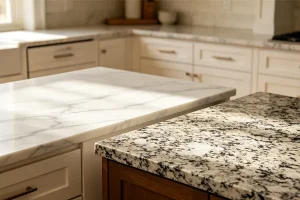
Why is quartz vs granite still the biggest countertop decision in kitchen design?
What is the real difference between quartz and granite?
Do granite countertops or quartz countertops win on durability?
Which countertop material handles stain, sealing, and daily cleanup better?
Is quartz or granite better for heat, hot pan use, and busy kitchen work?
Which looks better in a modern kitchen: quartz or granite?
Do granite slabs or quartz slab products offer more design flexibility?
Which is the better countertop for homeowners, developers, and wholesalers?
How should buyers compare quartz vs granite countertops for large projects?
Why does a reliable stone supplier matter as much as the material itself?
When clients compare quartz vs granite, they are really comparing two very different ideas of beauty and performance. Granite countertops are valued because they come from natural stone, cut from a quarry into a slab, with color movement and mineral variation that nature creates on its own. Quartz countertops, by contrast, are manufactured surfaces designed for consistency, easier upkeep, and repeatable color control.
That is why this comparison matters so much in a kitchen. A developer may want a uniform countertop program across many units. A designer may want dramatic movement and natural depth. A contractor may care most about fabrication speed and replacement risk. A wholesaler may need a dependable material mix for different markets. In short, quartz and granite are two very strong countertop options, but they solve different business and design problems.
As a stone manufacturer and supplier, I usually frame the issue this way: if the buyer wants lower day-to-day maintenance and more visual consistency, quartz usually leads. If the buyer wants a unique granite countertop with stronger natural identity and classic stone appeal, granite often leads. That is the real choice between quartz and granite.
The biggest technical difference is simple. Granite is a natural stone formed underground as molten rock cools slowly, which is why granite has a coarse, crystalline structure. Quartz countertop products are different: quartz is an engineered stone surface, typically made from ground quartz mixed with resin and pigment, then formed into large slabs. MSI and Caesarstone both describe quartz surfaces this way, and Caesarstone says many products are around 90% ground quartz with the rest made from resins and pigments.
That difference changes how the material behaves in real life. Since quartz is engineered, manufacturers can create a wide range of colors, more controlled pattern repetition, and marble-look designs with stable veining. Granite, on the other hand, is quarried and cut, so granite varieties show natural variation from block to block and slab to slab. That is exactly why many buyers say granite is unique while quartz feels more controlled and predictable.
So, when people ask about the difference between quartz and granite, the answer is not only “engineered vs natural.” It is also “controlled repeatability vs natural individuality.” That matters a lot when deciding on the perfect countertop for a single villa kitchen, a hotel program, or a multi-unit development.
On basic toughness, both materials perform very well, which is why both remain top-tier countertop material choices. Cambria says quartz offers exceptional chip and scratch resistance, while Natural Stone Institute materials describe granite as strong, abrasion-resistant, and suitable for heavily used surfaces. In plain terms, both handle daily kitchen life well when fabricated and installed correctly.
The more useful question is how that durability shows up in actual use. Quartz countertops offer a highly controlled surface with strong resistance to routine wear, and many quartz brands emphasize that quartz is resistant to stains, scratches, and day-to-day scuffs. Granite also performs very well, but because it is a natural material, the exact porosity and structure can vary by source, finish, and color.
My practical advice is this: if the client wants fewer performance variables across many kitchens, quartz usually feels safer. If the client wants the visual strength of natural granite and accepts that each slab of granite will be different, granite is still an outstanding long-term choice. In other words, granite vs quartz on durability is not a knockout fight. It is a close contest shaped by project priorities.
This is where quartz often pulls ahead. Cambria says its quartz surfaces do not require sealing, polishing, or reconditioning and are stain resistant because of their nonabsorbent nature. MSI says its quartz surfaces are engineered, resistant to stains and scratches, and require no sealing. That is why many buyers say quartz wins when the main goal is a low maintenance kitchen.
Granite needs a more nuanced answer. Natural Stone Institute care guidance explains that stone care depends on the stone and that sealing is often used as an extra precaution against stain penetration, not as a promise that the surface can never stain. Some granite may need the owner to seal or reseal based on porosity and use. That does not make granite weak. It just means granite countertops require a bit more attention than quartz in many kitchens.
So if the brief is “make it easy for the next homeowner,” quartz has a strong argument. If the brief is “give me real stone character and I accept periodic upkeep,” granite remains very attractive. That is often the true split in quartz countertops vs granite countertops.
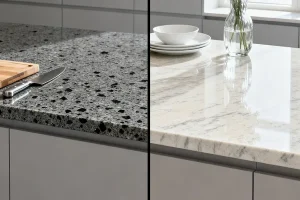
For heat, granite usually has the edge. Cambria’s own quartz vs granite countertops comparison says granite countertops excel in heat resistance, while quartz’s strengths show more in stain resistance and low maintenance. Quartz manufacturers also repeatedly note that quartz is heat resistant but not heat proof because the resin component can be damaged by excessive heat.
That is why I never recommend putting a very hot pan directly onto quartz, even if the brand says the surface is durable. Caesarstone says quartz is heat resistant, but trivets are still recommended for very high temperatures. Cambria also recommends protection from extreme heat exposure. So when clients ask whether quartz can handle a pan straight from the oven, the safer answer is no.
Granite is not indestructible either, and smart use still matters. But for aggressive daily cooking, many fabricators still lean toward granite if heat is the client’s top concern. In a chef-style kitchen, or in projects where the user treats the counter more like a workbench, granite often feels safer than quartz.
Visually, this is where there is no universal winner. Quartz shines when the client wants controlled movement, cleaner repetition, and strong availability in marble-look or soft-tone designs. Cambria says quartz provides a wider range of colors and styles, while Caesarstone and MSI both emphasize consistent design, polished aesthetics, and engineered flexibility. That makes quartz a strong fit for modern minimalism and repeatable unit design.
Granite appeals to a different taste. Because it is quarried and naturally formed, each granite countertop carries mineral variation, depth, and pattern movement that engineered material does not reproduce in exactly the same way. For buyers who want organic movement, rich contrast, or a stronger luxury-stone identity, granite still has a powerful draw. This is especially true in statement islands, villas, boutique hospitality, and premium custom kitchens.
So when a client asks whether quartz is better than granite, my answer is usually, “better for which look?” Quartz gives you design control. Granite gives you natural character. One is not automatically better. One is simply right for a different visual goal.
If “flexibility” means natural color variety from the earth, granite is very strong. MSI says its granite collection offers over 80 countertop colors, and granite suppliers typically present many colors of granite across different quarries and finishes. On Taide’s website, the public product center shows multiple granite families, including golden granite slab options, white granite selections, and sesame black granite stone choices. Taide’s product center also lists red, white, black, and golden granite categories for architectural use.
If “flexibility” means consistency and style control, quartz is hard to beat. Since quartz is engineered, makers can tune color, pattern scale, and movement across large runs much more predictably than natural stone. That is why developers and builders often like quartz programs for apartment kitchens, branded hotel units, and repeated floor plans.
For custom work, both can be excellent. A dramatic granite slab can turn a kitchen island into the star of the room. A controlled quartz slab can keep fifty units visually aligned. That is why the smartest answer is not just quartz or granite. It is which slab strategy best serves the project.
For the average homeowner, quartz often feels safer because it is simpler to live with. The daily cleaning routine is easy, sealing is not required, and the surface stays more uniform across the whole job. In a typical family kitchen or bathroom remodel, that convenience matters.
For developers, the answer depends on the project tier. Quartz often suits mid- to upper-mid-range programs where repeatability, speed, and standardized outcomes matter. Granite often suits higher-end or more design-led work where a client will pay for natural individuality. In premium villas, custom homes, and some hospitality work, granite still carries a status that many buyers value.
For importers and wholesalers, the decision becomes even more strategic. Quartz may simplify program sales because the patterns are easier to repeat. Granite may open more opportunity in markets that still prefer real stone. In short, one is right when consistency wins, and the other is right when natural identity wins.
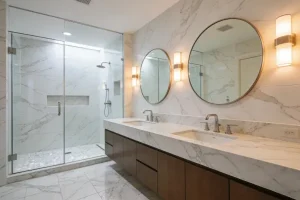
In large procurement, buyers should not stop at showroom beauty. They need to compare six things: material performance, stain and maintenance risk, heat behavior, pattern consistency, fabrication tolerance, and supply stability. That is the business side of deciding between quartz and granite.
A practical comparison table helps:
| Project priority | Quartz | Granite |
|---|---|---|
| Daily cleanup | Very strong | Good, but may need more care |
| Need to seal | Usually no | Sometimes yes |
| Heat tolerance | Good, but protect from very high heat | Generally stronger |
| Pattern consistency | Excellent | Natural variation |
| Natural stone appeal | Lower | Very high |
| Repeated multi-unit design | Excellent | Moderate |
| Unique statement surface | Good | Excellent |
This is why compare quartz with a project lens, not just a display-sample lens. The right countertop for a hotel brand standard is not always the right countertop for a luxury villa.
For B2B buyers, supply is half the decision. A beautiful countertop means very little if the slabs arrive late, the finish varies too much, or replacement stock is unreliable. Taide’s public about page says the company was founded in 2001 and operates major production bases and related building-material operations, while its product center shows a broad granite portfolio. That kind of supplier profile matters to contractors, developers, importers, and wholesalers who need continuity, not just samples.
That is why I would naturally guide buyers toward pages such as our stone factory and production background, the full granite product center, and the broader stone care and surface-finish article library. Taide’s news section also includes practical content on granite texture processing notes and white granite polishing workflow, which help reinforce technical credibility for buyers evaluating fabrication capability.
In other words, the best material choice is not just quartz or granite. It is quartz or granite plus the right supplier, the right fabrication plan, and the right service support. That is how professionals help you make better material decisions and reduce risk across the whole project.
Scenario 1: High-volume apartment kitchen program
If the goal is repeatability, easy cleaning, and low call-back risk, quartz often leads. Quartz countertops are engineered stone, they are nonporous, and major brands position them as easier to clean and easier to maintain without sealing. For standardized rollouts, that predictability is very attractive.
Scenario 2: Luxury villa or premium custom kitchen
If the buyer wants a dramatic island, authentic natural movement, and a stronger real-stone story, granite usually becomes more compelling. Granite countertops are natural stone, cut from quarry blocks into slabs, and each piece can offer distinctive movement that a manufactured surface does not match in exactly the same way.
Scenario 3: Mixed-use hospitality or commercial kitchen-adjacent project
If the project needs a balance of maintenance control, good looks, and procurement stability, the decision becomes more nuanced. Quartz may simplify specification, while granite may elevate premium zones such as show kitchens, bars, or feature counters. That is why quartz and granite countertops both remain top choices in professional sourcing.
Which is better, granite or quartz?
Quartz is usually better for buyers who want low maintenance, no sealing, and more consistent patterns. Granite is usually better for buyers who want real natural stone, stronger heat resistance, and one-of-a-kind slab character.
Are quartz countertops easier to maintain than granite countertops?
Yes. Major quartz brands say quartz surfaces are nonporous, stain resistant, and do not require regular sealing, while granite may need sealing depending on the stone and use conditions.
Can you put a hot pan on quartz or granite?
Quartz manufacturers say quartz is heat resistant but not heat proof, and they recommend trivets or hot pads. Granite generally performs better with heat, but careful use is still wise for any countertop.
What is the difference between granite and quartz in appearance?
Granite usually shows more natural variation because it is quarried stone. Quartz usually offers more controlled colors and more consistent patterns because it is engineered.
Is quartz better than granite for a kitchen or bathroom remodel?
Quartz is often better for a routine kitchen or bathroom remodel when ease of cleaning and low upkeep are the top priorities. Granite may be better when natural stone appeal and heat performance matter more.
Which material is the best countertop for large-scale procurement?
There is no single best answer. Quartz often works better for uniform, repeated installations. Granite often works better for premium custom work where natural variation adds value. The right choice depends on market positioning and supply goals.
Quartz vs granite countertops is really a choice between engineered consistency and natural individuality.
Quartz countertops usually win on stain resistance, no-seal convenience, and easier upkeep.
Granite countertops usually win on natural stone character and heat resistance.
Quartz is strong, but resin means very high heat still needs caution.
Granite is beautiful and durable, but some jobs may require sealing or resealing.
For large projects, supply stability, fabrication quality, and response speed matter as much as the material itself.
The best countertop is the one that matches the client’s real use case, brand position, and maintenance expectations.
If you are sourcing for contractors, developers, importers, or wholesalers, the smartest path is to compare quartz and granite not only by look, but by long-term project risk and procurement fit.

 English
  French
  German
  Russian
  Arabic
