Avoid your inquiry is delay response, please enter your WhatsApp/Skype along with the message, so we can contact you at the very first time.
We will reply you within 24 hours. If for urgent case, please add WhatsApp/WeChat: +8615063007107,. Or call 0086-15063007107 directly.
Granite tiles look beautiful, but the real question for any busy project is simple: will this tile floor stay strong under years of heavy use, carts, and foot traffic, or will it crack and stain too fast?
Yes. Granite tiles are very strong and durable for floors. Granite is a natural stone with high hardness (around 6–7 on the Mohs scale) and high compressive strength (often 100–250 MPa), which means a properly installed granite tile floor can handle heavy loads, rolling carts, and busy commercial traffic for many years with the right sealing and care.
As a professional stone manufacturer and supplier, I work every day with contractors, project developers, importers, and wholesalers who demand hard-wearing flooring tiles that can survive real job-site conditions. In this guide, I’ll walk you through how strong granite tile really is, where it shines, where its limits are, and how to decide if granite tile flooring is the right choice for your next flooring project.
Granite is an igneous rock, formed when molten magma cools slowly deep under the earth’s crust. That slow cooling time creates a tight, interlocking mineral structure. In simple words, granite is a natural stone made mostly of quartz and feldspar, and granite is one of the hardest common building stones used in construction.
On the Mohs hardness scale, granite usually measures 6–7, which means a granite tile resists scratches from most metals and common sand in outdoor areas. At the same time, the durability of granite under pressure is impressive: its compressive strength typically ranges from 100 to 250 MPa, far higher than many other flooring materials. This is why we often recommend a granite floor in lobbies, malls, airports, and busy corridors.
From my own factory experience, when we test a granite tile or granite stone sample, we see that granite is very resistant to impact and point loads if the subfloor is prepared well. This is one reason granite is an excellent choice when you need a durable flooring system that can live through decades of service with proper maintenance.

why granite tile so strong for floor use
Let’s compare granite tile flooring to other tiles for flooring, such as porcelain tile and ceramic tiles. We’ll focus on hardness, water absorption, and long-term durability.
| Material | Mohs Hardness | Water Absorption (typical) | Compressive Strength (typical) | Typical Use Cases |
| Granite tile | 6–7 | <0.5–3% (low) | 100–250 MPa | High-traffic commercial floors, outdoors |
| Porcelain tile | ~7+ | ≤0.5% (impervious) | High (varies) | Bathrooms, kitchens, wet areas |
| Ceramic tiles | ~5–6 | 3–10% or more | Lower than granite | Light-duty residential floors, wall tile |
Key points:
For investors and developers looking for popular flooring in malls or public buildings, a granite tile floor is not only about a premium look; it’s about real, measurable performance under pressure.
From a contractor’s point of view, there are clear pros of granite for tile flooring in commercial and public spaces.
In short, granite is a premium natural stone flooring option. For many of our B2B clients, granite is the right answer when they need a finish that signals quality and survives real-world traffic for years.
Of course, no flooring choice is perfect. It’s smart to look at the true pros and cons of granite before you sign off on a specification.
When we talk with clients, we explain that granite’s downsides are manageable if you plan proper sealing, cleaning, and load design from the start. Then the pros of granite far outweigh the cons.
Many specifiers ask whether granite tile is “tougher” than porcelain or ceramic tiles. The answer depends on what you mean by “tough”.
On hardness tests, porcelain tiles have an impervious water absorption rate of 0.5% or less, and lab tests show porcelain can be harder than granite at the surface. That’s why many guides say that thin porcelain tile can outperform thick ceramic in wet areas. Some buyers even Google “is granite more porous than ceramic?” The reality is more nuanced: granite typically has water absorption below 0.5–3%, while many ceramics are higher, so performance depends heavily on the exact product.
However, when we install a granite floor tile correctly over a strong subbase, we get a different kind of strength: massive compressive strength in the stone plus the “stone-on-mortar-on-concrete” system. For large tiles and granite assemblies in malls or train stations, this system behaves differently from thin-set porcelain over lightweight screeds.
In practice, we advise clients to use granite tiles come into play where heavy point loads, outdoor exposure, and a prestigious feel are top priorities, and to choose high-quality porcelain where ultra-low water absorption and lighter structural loads are more important.
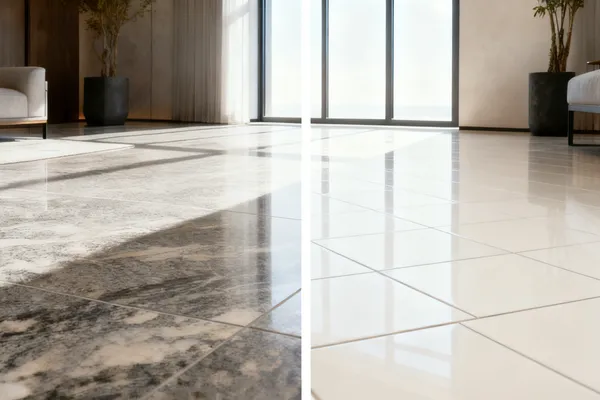
Granite floor tile vs porcelain and ceramic tiles
Finish changes everything. The same granite tile can look and perform very differently depending on the surface polish.
In many commercial projects, we mix finishes: polished granite in the lobby and textured granite outdoors. As a manufacturer, we can supply matching tiles and granite slab finishes so the whole design feels consistent.
From an architect’s point of view, granite floor tiles bring more than strength. They help shape the entire atmosphere of a space.
Because granite tiles come in various colors and patterns—from deep greens and browns to whites and golds—designers can create rich flooring designs that align with brand colors. In our catalog, granite tiles are available in many thicknesses and sizes, so tiles come in different modules that match your layout grids and traffic patterns. For feature areas, granite has been used together with other materials like marble and granite borders to emphasize key zones.
There are tiles available that look similar, but granite is a natural option that offers real mineral depth. With the right selection, you can pick tiles that suit both the interior concept and the functional needs of the space. For many clients, this mix of beauty and performance is one of the biggest benefits of granite for a commercial floor.
Even the strongest granite tile fails if the installation is poor. From years of working with installers across many countries, here’s what we recommend when installing a granite floor.
First, make sure the base floor is flat, strong, and clean. Loose screeds or weak concrete will crack under a heavy granite tile floor. The process of laying the tiles is similar to other stone tiles, but installing a granite system needs more attention to level and joint width because the tiles are heavier and less forgiving.
In our experience, installing heavy tiles is generally a job for professional crews, not DIY. On walls, a wall tile made of granite needs mechanical support in addition to adhesive. When clients use granite on both floor and wall, we often supply matching sets so tiles come with coordinated sizing and thickness.
For granite tile installation, we advise high-performance mortars designed for low-absorption stones. Joints must allow for movement and temperature changes. When you install granite in big areas, you also need expansion joints to avoid cracking. Properly using granite tiles this way extends the life of the whole system.
As a manufacturer, we support specifiers with detailed laying guides and can provide site advice for installing a granite floor in malls, airports, and high-end residential towers.
Because granite is a natural stone, it works across many zones—but each zone has its own rules.
In a commercial kitchen, for example, a textured granite tile floor behind the line can handle heat and dropped tools. For a public bathroom, honed or textured granite flooring is available to reduce slip risk and handle cleaning chemicals. In both spaces, sealing is critical to protect against grease and stain-forming spills.
We also see a lot of demand for granite countertop and kitchen countertops in food courts and show kitchens, with matching granite tile countertops or backsplashes. Here, the combination of granite floor, wall tile, and counters delivers a consistent, premium look that is easy to maintain when sealed correctly. For hotel lobbies, galleries, and museums, granite stone tiles handle the heavy rolling loads of trolleys and exhibition equipment much better than many lightweight alternatives.
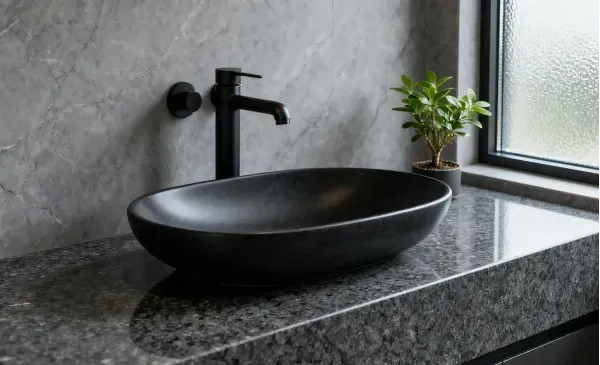
granite tile bathroom design
Not all granite looks or behaves the same. Different types of granite come from different quarries and have different mineral mixes.
For example, black granite usually appears slightly harder and denser on average, while light materials like Kashmir White Granite offer a softer, elegant appearance that designers love for malls and showrooms. As a factory, we supply both granite slabs and cut-to-size granite tiles, so you can combine slab cladding on walls with tile floors in the same stone family.
In many specs, granite can also be combined with other products: instead of solid granite everywhere, some clients use tiles in the main zones and slabs at feature walls or concierge desks. This lowers cost but keeps a consistent look of granite where it matters most.
Good maintenance is the secret to keeping a granite tile floor looking new for decades. Here are the basics we share with our B2B partners to keep your granite in top condition.
For many of our export clients, the combination of structured maintenance and strong material means granite is the right long-term investment for their floor finish.
To show how all of this works on a real job, let me share a typical flooring project we support.
A developer planned a mid-size shopping center. They needed tiles for flooring in entrances, corridors, kitchen prep areas for food tenants, and public bathroom zones. After reviewing different flooring options, they decided on a mix of tiles and granite:
For them, tiles are versatile tools. They used different finishes and thicknesses like a design kit. In food-court areas, tiles also needed to resist oil and dye spills, so we selected a darker stone and stronger sealer. In a few highlight zones, tiles are also laid in patterns to create visual cues for customers.
Because granite tiles come in many sizes, and granite tiles come in different patterns and surface finishes, we could supply tiles that suit each zone while keeping logistics simple. From our side as a manufacturer, we shipped full containers of matching granite tile and slabs, along with technical support on granite tile installation and maintenance.
Choosing granite tile is only half the story. The other half is choosing the right partner to supply it.
As a professional stone manufacturer and supplier, we:
For contractors, project developers, importers, and wholesalers, this means fewer surprises on site, more reliable lead times, and a strong technical partner behind every granite tile floor you build.
If you are planning a new commercial building, mall, hotel, or public space and want granite flooring is available as an option, we can help you review your design, select the right stone, and price out a full flooring project package.
Are granite tiles strong enough for high-traffic commercial floors?
Yes. With hardness around 6–7 on the Mohs scale and compressive strength typically between 100–250 MPa, a properly installed granite tile floor handles heavy foot traffic, trolleys, and everyday wear extremely well, especially in malls, airports, and office towers.
Do granite tiles stain easily?
Unsealed granite can absorb some liquids because granite is porous at a micro level. But once sealed properly and maintained on schedule, it becomes much more resistant to stains and everyday spills in kitchen, bathroom, and retail environments.
Is granite better than porcelain tile for floors?
It depends. Porcelain has extremely low water absorption and can be harder at the surface, so it’s excellent in very wet areas. Granite, on the other hand, offers a natural, premium look, massive compressive strength, and long-term value in many commercial settings. Many projects use both materials in different zones.
Can I use the same granite for floors, walls, and countertops?
Yes. Many clients specify the same stone as tiles for flooring, wall tile, and granite countertop or kitchen countertops. We often supply coordinated granite tiles and slab pieces so the whole project feels consistent from lobby to washroom to food court.
Is marble and granite the same in terms of strength?
No. While both are natural stones, granite is generally harder and more scratch-resistant than marble, making it a safer choice for high-traffic tile flooring. Marble may be better suited to lighter-use or feature areas where visual impact is more important than maximum wear resistance.

 English
  French
  German
  Russian
  Arabic
