Avoid your inquiry is delay response, please enter your WhatsApp/Skype along with the message, so we can contact you at the very first time.
We will reply you within 24 hours. If for urgent case, please add WhatsApp/WeChat: +8615063007107,. Or call 0086-15063007107 directly.
You want a beautiful new kitchen, but you are stuck on the big question: granite or quartz countertops. The more photos you see, the harder it feels to choose. Let me walk you through the look, feel, and facts so the prettier option becomes clear.
When you compare granite and quartz, neither one wins for everyone. Granite often looks wilder and more natural, while quartz countertops give a clean, even style. The “prettier” choice depends on your home, your taste, and how much work you want to put into care and cleaning.
If you are building or remodeling a kitchen, it makes sense that you are drawn to granite countertops and quartz countertops. In the classic granite vs quartz debate, both options have strong fans. They are two of the most popular options because they look high-end, feel solid, and can match almost any cabinet color. From bright white to deep charcoal, there is a look for every space.
As a professional stone manufacturer and supplier, I see the same question from every type of customer, from a single homeowner to large contractors: “Which surface will look better in my project long term?” The honest answer is that it is a matter of aesthetics and lifestyle. Both countertop materials can be stunning; the key is to match the material to how the space is used.
To help you decide, I will show you the real differences between quartz and granite in simple language. We will talk about how each slab is made, how colors and patterns appear, what kind of maintenance they need, and how your choice can support a longer-lasting, more beautiful kitchen.
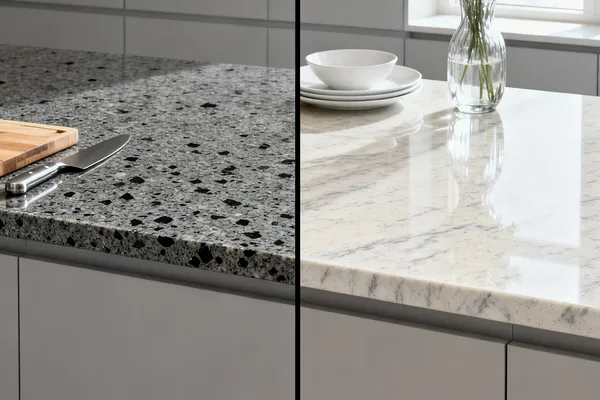
Granite and Quartz Countertops
Granite is an igneous rock. More exactly, granite is an igneous rock composed of minerals like quartz, feldspar, and mica. This mix is why granite is a very hard, real stone that can handle daily life in a busy home or commercial space.
Granite comes from a quarry as giant blocks. Each block is cut into a slab of granite, polished, and turned into a granite countertop. Because granite is a natural stone, every slab is different. When you look closely, you are seeing natural materials that formed deep underground over millions of years.
Quartz is actually different. Quartz is man-made in the sense that the final sheet is put together in a factory, even though it still uses ground natural quartz crystals. A typical quartz product is about 90–95% natural quartz mixed with 5–10% polymer resins and a small amount of pigment. This mix is pressed and baked into engineered stone.
Because of this blend, quartz surfaces are often called engineered quartz or even called engineered stone. In other words, they are natural or man-made at the same time: they start with minerals from the earth, but the shape, thickness, and style are created by an engineer in a controlled plant.
From our own fabrication line, we see that this tight control means fewer flaws, smoother edges, and very steady color from piece to piece.
When clients ask which material is prettier, they are really asking about colors and patterns. Granite countertops offer big flowing veins, tiny flecks, swirls, and waves. Granite surfaces can have wild movement or very calm, small-grain patterns. No two pieces look exactly alike, which gives a strong feeling of uniqueness.
Many design experts still love the drama of natural granite for this reason. In photos, you can see how stone surfaces with rich movement become the star of the kitchen. If you want a room that feels special and one-of-a-kind, granite and quartz can both work, but granite often steals the show.
Quartz, on the other hand, shines when you want consistency. Since quartz is actually engineered in a factory, the colors stay even from corner to corner. You can choose white with soft gray veins like marble, warm beige like granite, or bolder looks. Because we control the mix, we can repeat the same look across many apartments, hotel rooms, or office kitchens.
Here is a quick look at how the aesthetics compare:
|
Feature |
Granite Countertops |
Quartz Countertops |
|
Look |
Natural, varied, sometimes dramatic |
Clean, even, can imitate marble or concrete |
|
Pattern |
Random, each slab unique |
Controlled, repeatable between lots |
|
Best for |
Buyers who want real stone character |
Buyers who want calm, modern lines |
|
Color range |
Earth tones, blues, greens, golds |
Almost any tone, including very bright whites |
|
Matching many units |
Harder, because every slab is different |
Easier, because patterns are repeated |
In large projects like condo towers or malls, this control matters. When you need many units to match, quartz and granite countertops are not the same: quartz might be the better choice if you care most about consistent beauty from floor to floor.
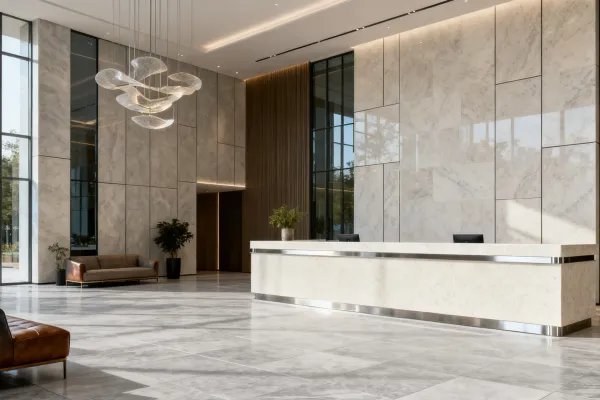
Granite Hotel Lobby
From the first touch, you can feel that granite is a natural stone. The tiny pits, crystals, and grain make it feel like granite, even when it is polished to a gloss. Many people love this “real rock” feeling under their hand when they lean on the island or wipe a kitchen countertop after dinner.
Quartz, by contrast, feels sleek and smooth. Because the surface is non-porous, it does not have the tiny breathing holes that granite has. Engineered stone countertops feel a bit more “soft” to the touch, even though they are a very durable material. Some people say it feels like fine porcelain tile, but thicker and more solid.
If you walk through showrooms, you will notice that the differences between the two are much easier to feel than to see in photos. That is why we always invite project developers and wholesalers to run their hands across the displays. Your brain registers the difference even if you do not have the right words yet.
From an appearance standpoint, both types of stone surfaces can look luxurious. For many clients, the choice between quartz or granite comes down to one simple question: “Do I want movement and variety, or do I want smooth, even color?”
Pretty today does not help you if the surface looks worn in five years. That is why we talk so much about durability and care with our customers. While granite is a natural stone, granite is a porous material. Without a proper seal, liquids can soak in and leave a dark stain.
Quartz, on the other hand, is built as a non-porous surface. Because it has resin and polymer resins binding the crystals together, it does not soak up spilled liquids in the same way. This is why many families and busy cafés like quartz surfaces: they stay fresh and bright with simple care.
Here is a simple care comparison:
|
Care Point |
Granite Countertops |
Quartz Countertops |
|
Sealing |
Needs a seal once a year or so |
No sealing needed |
|
Stain risk |
Higher if not sealed |
Naturally stain-resistant and very stain resistant |
|
Cleaning |
Warm water and mild soap |
Warm water and mild soap |
|
Reseal over time |
You should reseal on a regular schedule |
No reseal required |
When it comes to comparing quartz and granite countertops, most tests show that quartz is more stain-resistant and more maintenance-free. Granite still performs very well, but it does ask for a little more love. With both, regular gentle cleaning keeps the shine and helps the space look cleaner overall.
For big commercial cafeterias or rental units, this low care can be a major design factor. Fewer special products, fewer service calls, and fewer worries about a forgotten spill turning into a permanent mark mean the surface keeps its “like new” beauty longer.
Beauty in a kitchen is not just about color. It is also about how the surface holds up to a hot pan, a splash of oil, or a juice box spill. Granite is a very hard natural stone and quite heat resistant. You can place hot pots and pans briefly on many granite countertops without damage, though using a trivet is still smart.
Quartz is very tough but reacts differently. The resin in quartz can change color if a hot pan sits too long in one place. That is why we always tell clients to use a board or mat on quartz countertops when they cook, even though the surface itself is a durable material.
Stain risk is the other side of this story. Granite is a porous stone. If oil, wine, or another dark liquid sits for a long time without a good seal, it can leave a stain that is hard to remove. With quartz, the non-porous face blocks most spilled liquids before they sink in, so a quick wipe is usually enough.
In real projects, we see that both materials handle daily life well when installed by a pro. The key is to train the users: wipe up a spill, do not drag heavy pots, and give the stone a little care. With that, both stay bright and glossy for many years.
Of course, “prettier” is not only about looks; budget also has a voice. In many markets, the cost of granite and the cost of quartz overlap, but there are still clear ranges per square foot. Recent guides show that quartz countertops often run from about $50 to $120 per square foot installed, while granite commonly ranges from around $80 to $150 per square foot installed, depending on color, origin, and thickness.
In simple terms:
As a manufacturer, we help our partners choose the right countertop material mix for each project phase. For model rooms, you may choose a high-drama natural stone countertop; for standard units, you might move to a calmer engineered stone to keep costs and maintenance stable.
When you order in bulk from a factory like ours, we also optimize fabrication to reduce waste. That means more use from every slab and a better final price without cutting corners on quality.
For a warm, classic look, many owners still lean toward natural granite. A medium-cream or brown granite countertop pairs wonderfully with wood cabinets and stone floors. It feels cozy and timeless. In a kitchen or bathroom that needs a calm, spa-like feeling, soft gray or beige granite can be a great match.
Modern designers often lean toward pale quartz surfaces with fine veining. White or light gray quartz countertop designs bounce light around the room and make small spaces feel larger. These clean lines work well with flat-panel cabinets, steel appliances, and open shelves.
Here are simple style guides:
As a supplier, we keep a wide gallery of different colors and patterns ready so you can see samples on-site. We know that seeing the stone next to your cabinet door and floor tile is the best way to feel that instant “yes.”
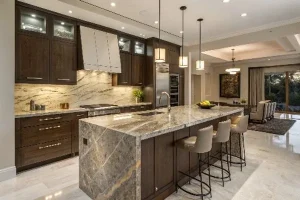
Granite kitchen island counter
Many trade clients now ask us directly about cambria quartz vs traditional granite. Cambria quartz is a premium brand of engineered stone from the United States, known for rich color design and high performance in tough, daily-use spaces.
Cambria quartz focuses on deep veining, crisp whites, and designs that look very much like granite or marble but stay non-porous and low care. For multi-unit projects that need a consistent, upscale look, this type of quartz product makes planning much easier. You can specify one pattern and trust that every batch will match.
Natural granite, on the other hand, has a charm you cannot fully repeat. Every slab has its own story written by the earth. When a hotel lobby or luxury villa wants to impress guests with a one-of-a-kind reception desk or island, every slab feels like a custom artwork.
In practice, we often mix both in the same project:
This blend keeps maintenance low for daily use while still giving some key spots the “wow” factor of real stone.
If you work as a contractor, project developer, importer, or wholesaler, your questions go beyond “which is prettier today.” You also care about lead time, stock control, and how easy it is to replace a damaged top years later.
From that angle, engineered stone can be easier to manage. Since quartz is actually produced in controlled batches, we can reserve a series of slabs for your job and repeat the same pattern in new phases. For chain stores, hotels, and large housing projects, that repeat pattern saves time and avoids awkward color changes.
Granite shines when your project needs a strong natural story. Some buyers love the idea that granite is a natural stone pulled directly from the earth. If your marketing stresses natural materials, local stone, or unique luxury, granite and quartz can be positioned side by side so clients can feel the difference.
As a factory, we support both paths. Our engineers can help you test samples under acid, heat, and impact before you commit. We also give layout drawings so you can see how seams will fall across each island or run.
Picking between quartz and granite can feel overwhelming at first, but once we look at your drawings and talk through use, the better choice usually appears quickly.
Here is the simple framework we use with our trade partners:
We also look at building or remodeling timelines and stock. With early planning, we can align quarry production or engineered stone runs with your shipping schedule, helping you avoid delays.
Most importantly, we listen. Some clients walk in sure they want quartz or granite and leave with the opposite after seeing real samples in the light. That is normal. The key is to make a choice you still love when you walk into the finished room years later.
No matter which material you choose, good care keeps the beauty alive.
For both granite and quartz:
For granite specifically, remember that granite is a porous stone and needs a seal to protect against deep stains. Follow the sealer directions and reseal as recommended.
For quartz, never place a hot pan or baking tray straight from the oven onto the top. The resin can discolor if it faces extreme heat again and again. Use a mat or trivet and your surface will stay bright for many years.
In our own projects, we find that when users follow these simple rules, both kinds of countertops offer long service lives with minimal trouble.
Is granite or quartz more beautiful in a modern kitchen?
In a modern space with clean lines and flat cabinets, many people choose pale quartz for a calm look. However, a dark, fine-grain granite can also be stunning. It depends on whether you want a quiet background or a bold focal point.
Which looks more natural, quartz or granite?
Granite looks and feels like real rock because it comes straight from the earth. Quartz can imitate this look very well, especially in newer designs, but if you want pure natural stone character, granite still has the edge.
What should a busy family choose for a pretty but easy-care surface?
Most busy families, cafés, and rental units pick quartz for its low care, strong stain resistance, and smooth, even color. It stays fresh-looking with simple wiping, even when life gets messy.
Can I mix granite and quartz in one home or project?
Yes. Many designers mix them: for example, a dramatic granite island as the centerpiece and calm quartz along the walls. As a stone supplier, we often help clients coordinate colors so the mix looks planned, not random.
Does one material add more resale value?
Buyers mainly want a solid, attractive upgrade, so either option can help. The key is quality stone, good edge work, and a professional installation. A well-designed stone kitchen feels like a luxury upgrade no matter which material you pick.
As a professional stone manufacturer and supplier, we have helped hundreds of contractors, developers, importers, and wholesalers choose, cut, and deliver both granite and quartz to projects around the world. We understand how small details, from edge polish to crate packing, change the final result on-site.
If you are planning a project now, here is how we can support you:
When you are ready, share your drawings and quantity list with our team. We will suggest matching stones, prepare a quote, and help you decide which material will be the prettier and smarter choice for your next project.

 English
  French
  German
  Russian
  Arabic
