Avoid your inquiry is delay response, please enter your WhatsApp/Skype along with the message, so we can contact you at the very first time.
We will reply you within 24 hours. If for urgent case, please add WhatsApp/WeChat: +8615063007107,. Or call 0086-15063007107 directly.
Stuck choosing between ceramic tile and granite? Costs, care, and performance all pull in different directions. That tension gets worse under wear and tear on a busy floor or countertop. Here’s a clear path through the noise—and a practical solution.
Granite is tougher and more durable for heavy-duty tile flooring, outdoor areas, and premium finishes; ceramic tile (and high-density porcelain) brings lower cost, consistent looks, and easier care for most homes and commercial spaces. Pick based on foot traffic, water exposure, budget, and style needs.
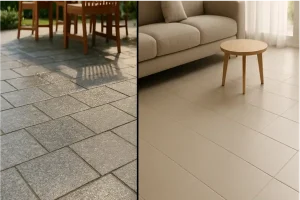
Ceramic tile is fired clay; porcelain is a type of ceramic fired hotter and denser. Granite is a natural stone formed under pressure deep in the earth. That’s the core difference between ceramic and granite: man-made vs mined natural stone tiles.
From a performance lens, granite is a natural stone with interlocking crystals. That makes it extremely durable, with high scratch resistance. Ceramic tiles may chip if struck hard at edges; porcelain and granite handle impact better. For a look at rugged outdoor texture, see granite flooring with litchi surface—a great non-slip choice for plazas and entry stairs.
“On heavy-traffic concourses, granite keeps edges crisp for years; tiles are versatile, but you must match density and finish to the zone.” — Project Director, transit hub upgrade
In high-load zones—lobbies, corridors, shopfronts—granite is famously durable. Granite’s dense mineral mix resists wear and tear, meaning fewer chips along corners and thresholds. Granite requires periodic sealing, but properly sealed stone is resilient against common stain risks.
Ceramic tiles are easier to install in standard grids and offer predictable sizes; however, they’re not always as durable as granite at edges under cart traffic. That said, modern glazed ceramic tiles with hardened glaze tops can take years of use if you set the right rating. Tiles provide reliable consistency across large areas, making it an ideal choice for many commercial floors.
Explore a textured option that excels under foot traffic: granite tile for floor (Linshu Blue).
When you need a tightly controlled look, ultra-low water absorption, and thin formats, porcelain vs granite can get interesting. In porcelain vs granite, porcelain is the clear winner for consistency and very low absorption; it’s engineered to be dense and uniform, great where hygiene and moisture control matter.
By contrast, granite offers unique mineral patterning and unmatched long-term polish retention. For exterior stairs and plazas, flame-finished granite tile is hard to beat. For kitchens with a minimalist, monocolor look, premium porcelain countertops can pair with stone or wood cabinetry. (We fabricate both, and advise based on use case.)
For clean, modern outdoor planes, see our granite paving range.
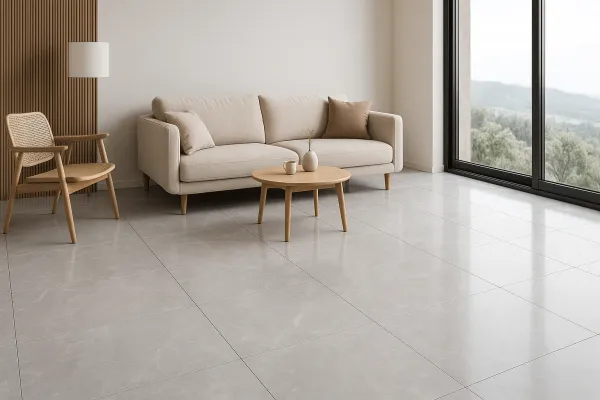
Tiles are typically thinner and lighter, so shipping is cheaper than transporting granite. With stone, weight and the need for crates, edge protection, and lifting gear add up. Granite has a higher upfront cost than standard ceramics, especially for large slab formats or custom shapes.
Tiles are generally more affordable per square meter in standard sizes. However, stone’s life-cycle value can be excellent in hard-wear public zones. Tile installation is often faster on flat, engineered substrates; large granite formats may require additional substrate checks and handling gear.
See our factory capabilities as a granite supplier for bulk jobs: Factory Display.
With ceramic, glazed tiles shed grime easily and are easy to clean with neutral cleaners. (For ceramic care tips, see ceramic tile – Granite Gold®; if you use that brand, always follow label directions.) For granite, a breathable seal minimizes stain absorption while preserving the stone’s surface energy.
Tiles require routine grout cleaning. Granite offers broader finishing options—flamed for traction outdoors, honed for soft matte in museums, polished for hotel lobbies. Each surface sets a different maintenance plan and ease of maintenance expectation.
Compare polished and honed looks in our granite products library.
Outdoors, thermal shock and freeze–thaw cycles matter. Porcelain pavers perform brilliantly on raised deck systems or pedestal supports. For monumental steps and plazas, granite in flamed finish is a popular choice with tactile grip and long service life—ideal for high-traffic areas across campuses and transit squares.
Indoors, tile flooring (ceramic or porcelain) handles daily abrasion well. In porticos and thresholds, granite instead of ceramic tile curbs edge spalling. For a rugged exterior wall or stair set, slate can also work, but granite remains the benchmark for toughness.
Outdoor example: flamed Shidao Red granite.
Color and pattern differ by material. Ceramic tiles offer print precision—wood-looks, terrazzo-looks, and concrete-looks—available in a wide range of sizes. Granite brings natural beauty with mineral flecks and sweeping movement; granite comes in cool blues, warm golds, and inky blacks.
Choosing slabs and tiles of granite enables feature stairs, long thresholds, and book-matched walls. Unglazed tiles give soft, architectural matte indoors; glazed ceramic tiles deliver graphic effects. Tiles also enable tight joints and modular layouts, ensuring that each tile aligns with pattern intent across large halls.
See the deep blue granite stone tone in Polished Linshu Blue.
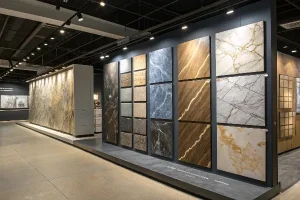
For kitchen islands and kitchen countertops, granite countertops offer unmatched luxury and heat tolerance. Choice for bathrooms and kitchens often leans to porcelain for its dense body and consistent finish in showers. Excellent choice for bathrooms: finely textured granite tile on floors plus porcelain walls.
In corporate lobbies, granite flooring sets a premium tone. For retail rollouts, tiles are typically the fastest to standardize across multiple sites. Ceramic tiles may not last as long at sharp edges under carts, compared to granite, so we specify trim profiles there.
A warm stone for vanities or feature walls: Karamori Gold (polished).
Both choices use natural materials. Types of natural stone include granite, marble, and others; ceramic is clay-based and kiln-fired. Granite is one quarried product—cut, finished, and installed with decades of service life. Tiles offer thin-body efficiency and can travel more units per crate than stone.
As a professional stone manufacturer and supplier, we optimize block yield, select regional quarries to shorten routes, and pack for safe transporting granite. That reduces breakage and keeps timelines tight.
Learn more about our export workflows as a granite exporter
Use this quick guide when choosing between granite and choosing between ceramic surfaces:
Traffic & impact
Water & chemistry
Aesthetics
Budget & speed
One-sentence tip: Pick by use zone first, then finish, then budget.
| Property | Granite (natural stone) | Porcelain (ceramic) | Standard Ceramic Tile |
|---|---|---|---|
| Scratch resistance | Very high | High | Medium |
| Water absorption | Low (sealed) | Very low | Low–medium |
| Outdoor freeze–thaw | Excellent (flamed) | Excellent | Varies |
| Format | Slabs and tiles, custom | Modular tiles | Modular tiles |
| Maintenance | Seal periodically | Minimal | Minimal |
| Lifespan | 30–50+ years | 20–40+ years | 10–25+ years |
Notes: Always verify slip resistance for the specific finish (e.g., flamed granite or textured porcelain). Flooring materials must match local codes.
A civic plaza resurfacing needed tough, non-slip steps, plus uniform concourse tile that crews could lay quickly. We used granite with flamed finish for stairs and thresholds and dense porcelain modules for the concourse. Five years in, edges are still crisp, and cleaning crews report predictable ease of maintenance.
For product care, see brand guides like ceramic tile – Granite Gold®. If you use that brand, always test in a corner first—and if you like it, try granite gold® today for ongoing maintenance.
Is ceramic durable enough for a busy mall floor?
Yes—if you choose dense bodies and the right rating. Still, edges near carts are durable than ceramic with granite, so we often detail metal trims there.
Can I use porcelain instead of granite on outdoor stairs?
You can, but for tactile grip and long-term edge integrity, flamed granite is often the excellent choice. Pair porcelain tiles on flat terraces with stone on nosings.
What finish is safest in wet areas?
Textured granite or structured porcelain. Choice for bathrooms often blends porcelain walls with granite thresholds.
Do I need to seal ceramic or granite?
Ceramic usually does not; granite requires periodic sealing. Follow the sealer maker’s schedule.
Can porcelain look like natural stone?
Yes. Tiles offer stone-look prints with remarkable fidelity. Unlike granite, prints repeat on a cycle, so lay patterns thoughtfully.
How heavy is stone compared to tile?
Heavier. Plan for transporting granite, hoists, and crew training. Tiles are typically lighter and faster to stage.
Scores are normalized (1 = low, 10 = high). Lower values for water-absorption and maintenance indicate easier upkeep.
As a professional stone manufacturer and supplier, we source blocks, cut bespoke formats, and deliver both granite and compatible tile solutions. From quarry selection to site delivery, we coordinate finishing, sizing, and crate plans—ensuring that each tile and stone piece arrives ready to install.
Credits & references: general material properties summarized from trade handbooks and standards bodies (Britannica, TCNA, ISO/ASTM) and our field logs.
P.S. If you need tailored samples, sizes, or finishing guides, we’re happy to help with mockups and schedules—tiles are typically quick to ship, and stone leads the way for signature architecture.

 English
  French
  German
  Russian
  Arabic
