Avoid your inquiry is delay response, please enter your WhatsApp/Skype along with the message, so we can contact you at the very first time.
We will reply you within 24 hours. If for urgent case, please add WhatsApp/WeChat: +8615063007107,. Or call 0086-15063007107 directly.
Big builds need truth, not hype. You’re choosing finishes that last. Yet there’s confusion about what marble really is—and how it behaves on a floor, tile, or countertops. Pick wrong, and stains, etch marks, and delays follow. Here’s a clear, contractor-level guide from a professional stone manufacturer and supplier.
Yes—marble is a natural stone. Marble is a metamorphic rock formed when limestone undergoes metamorphism under heat and pressure. It is mostly made of calcite (a carbonate mineral), with crystalline mineral grains that create its iconic veins, natural colors, and patterns. It’s real marble, not engineered.
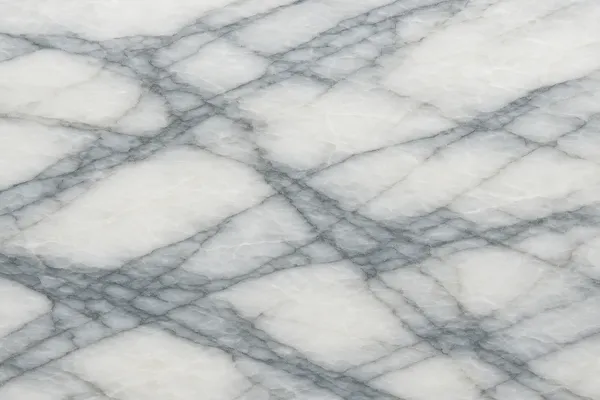
Marble comes from nature. Marble is a metamorphic rock. It starts life as limestone and undergoes metamorphism deep in the Earth. Over time, heat and pressure rearrange the mineral grains into a tight crystalline structure. That’s the characteristic of marble you see as soft veining and luminous depth.
Chemically, marble is dominated by calcite (the mineral calcite), a carbonate mineral composed of calcium carbonate. Marble also can include dolomite, clay, mica, or graphite in small amounts, which add movement and color. This is real marble—a timeless building material and building stone used across cultures.
“In practical terms, marble offers natural beauty and workability that designers love, with a look no engineered surface can fully copy.”
Related reading: Explore our natural stone like marble collections for large commercial specs.
Geologically, marble is formed when limestone undergoes metamorphism inside the crust. As temperatures rise to high temperatures (often hundreds of degrees Celsius) and pressure increases, the limestone’s mineral grains recrystallize into a denser crystalline rock. That’s why the surface of the marble can be polished to a reflective glow.
Some marble that contains dolomite will read slightly harder than pure calcite marbles. Trace minerals create marble patterns—the vein networks you see—ranging from pure white marble (like Thassos) to colored marble tones. Marble also occurs as green marble (often with serpentine) and dramatic blue marble selections.
Useful spec link: See our stone products for cladding and interiors with quarry-direct sourcing.
Both marble and granite are natural stone, but they behave differently. Granite forms as an igneous rock; marble is metamorphic. For countertops and floor areas with heavy wear and tear, compare the basics:
Performance comparison (typical ranges):
| Property | Marble | Granite | Quartz (engineered) |
|---|---|---|---|
| Mohs hardness | ~3–4 | ~6–7 | 7 |
| Porosity | Medium (more porous) | Lower | Very low (non-porous surface) |
| Etching (with acidic spills) | Can etch | Rare | No etch |
| Heat tolerance | Good | Excellent | Good |
Marble is extracted from a quarry, cut into blocks, then sawn into slab and marble tiles. Legendary Carrara quarries in Italy produce Carrara marble, the classic Italian marble specified worldwide. Greek Thassos delivers a pure white look prized for contemporary spaces.
The marble surface owes its character to calcite mineral grains and re-crystallization. This microstructure refracts light, giving that soft “glow.” It’s the characteristic of marble most clients notice first—the way natural colors and veining flow across a panel.
Project help: Explore vein-matched wall kits to align patterns across corridors and lobbies.
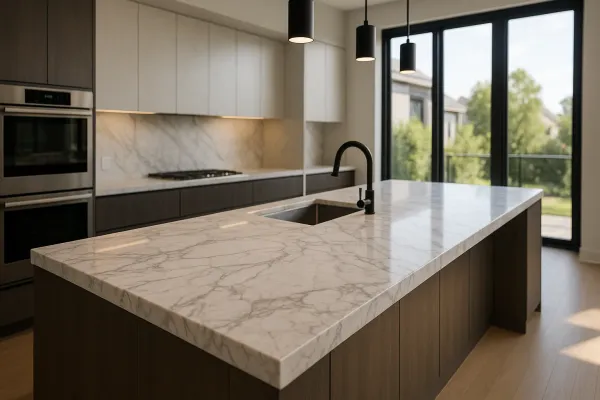
Marble is used in many zones: reception desks, feature walls, a marble floor in a lobby, tile bathrooms, and boutique countertops. In kitchen spaces, choose a finish and care plan that fits daily traffic. In a bathroom, marble reads serene and upscale, especially as honed tile.
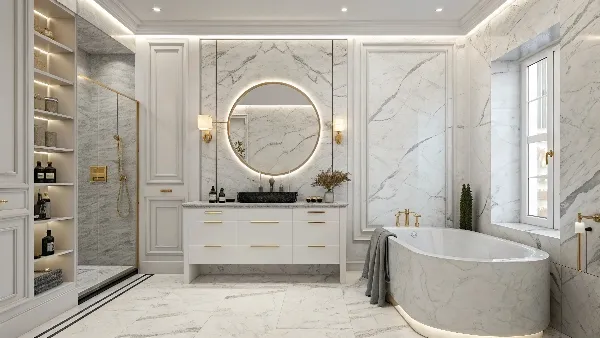
Because calcite reacts with acidic liquids (lemon, vinegar), marble can etch—a dull spot that reflects damage to the surface. It may also stain if spills aren’t cleaned or if sealer is overdue. The fix: seal properly, wipe spills fast, and clean with ph-neutral products.
Contractor tip: schedule maintenance with your GC closeout plan. It keeps countertop and countertops looking new.
Designers ask for white marble a lot, but choice is wider:
Each category appears in polished, honed, or leathered finishes—select for wear and tear and cleaning targets.
Use marble tiles for bathrooms and corridors where modular replacement is helpful. Choose slab for reception desks, wall monoliths, and marble countertops (islands, vanities). For very heavy traffic or back-of-house kitchen prep, granite or engineered quartz are easier to keep pristine.
Spec support: Our stone fabrication and installation team optimizes tile and slab yield for schedule and budget.
Across centuries, stone has been used in monuments and cities. American quarries supplied marble to build the Lincoln Memorial; in India, the Taj Mahal is clad in luminous marble. That continuity is why marble remains a designer favorite—timeless, repairable, and recyclable.
As a professional stone manufacturer and supplier, we build long-term supply plans, sample approval loops, and mockups that de-risk execution for developers and contractors—so your stone products arrive aligned, labeled, and on time.
| Stone | Composition | Absorption | Notes |
|---|---|---|---|
| Marble | Mostly calcium carbonate (calcite) | Medium | Glows when polished; seal to reduce stain risk |
| Granite | Quartz, feldspar, mica | Low | Tough choice for heavy traffic |
| Limestone | Calcite, fossil fragments | Medium | Softer look; some dense types perform well |
| Travertine | Banded limestone | Medium | Filled & honed looks modern |
| Quartz (engineered) | ~90% quartz | Very Low | Stable non-porous surface for strict hygiene |
Application priority (higher = better fit)
Lobby feature wall:        ███████████ (Marble)
Back-of-house prep:        ███████████████ (Granite/Quartz)
Wet-area vanity:           ████████████ (Marble/Quartz)
Airport concourse floor:   █████████████ (Granite)
Residential kitchen island ███████████ (Marble with care)
(Use this as a conversation starter—not a substitute for a site-specific spec.)
A developer chose Italian marble from Carrara. We block-matched from the quarry, produced marble slab and book-matched panels, then coordinated panels by room. Delivery: eight weeks faster than the GC expected. Result: a quiet, luxury marble lobby that anchors the leasing experience.
Similar looks: See book-matched Carrara feature walls.
Is marble a natural stone or synthetic?
Marble is a natural stone. Geologically, marble is a metamorphic rock—metamorphic rock formed when limestone undergoes metamorphism inside the Earth.
What’s the difference between marble and granite for countertops?
Granite is harder and more stain-resistant. Marble looks softer and more luminous. For countertops, either can work, but granite countertops shrug off wear and tear better. Many clients use marble elsewhere and granite or quartz in busy kitchens.
Will marble stain or etch?
It can stain and etch with acidic spills. Use a quality seal, clean with ph-neutral products, and wipe spills fast to prevent stains. Serious issues? Call a stone restoration pro.
Is marble porous?
Yes, marble is porous compared to granite and quartz. A seal reduces absorption and keeps finishes uniform.
Which varieties should I consider?
Carrara marble for classic gray veining; Thassos for pure white; black marble for drama; green marble and blue marble for accents. We’ll match marble types to your design and budget.
Where is marble used historically?
From temples to civic halls—famously to build the Lincoln Memorial and the Taj Mahal—a reminder that marble is used where longevity and craft matter.
(These references support the geology and heritage notes above.)
As a professional stone manufacturer and supplier, we plan for success: synchronized lot selection, block booking at the quarry, mockup approvals, engineered anchorage for cladding, and labeled site packs. That way your kitchen, bathroom, lobby floor, and feature tile install smoothly—on schedule.
See end-to-end stone supply for developers and commercial marble tile packages.
Glossary one-liners for specs
Need samples, shop drawings, or a unit-rate takeoff? We support design teams and contractors with fast submittals and clear logistics so your schedule holds.

 English
  French
  German
  Russian
  Arabic
