Avoid your inquiry is delay response, please enter your WhatsApp/Skype along with the message, so we can contact you at the very first time.
We will reply you within 24 hours. If for urgent case, please add WhatsApp/WeChat: +8615063007107,. Or call 0086-15063007107 directly.
Choosing the wrong marble for a large project can lead to delays, mismatch, and costly replacement. One slab may look perfect in a sample room but fail your design, budget, or supply plan at scale. The smart fix is to understand the 3 marble types before you buy.
The three most discussed types of marble in premium building and design are Carrara marble, Calacatta marble, and Statuario marble. All are prized Italian white marble varieties, but they differ in background tone, veining, rarity, and price. For contractors, importers, and project developers, knowing these differences helps with better material selection, budgeting, and long-term project results.

Marble floor
What is marble, and why is it still a top natural stone choice?
What are the three types of marble?
What makes Carrara marble so popular?
Is Calacatta marble better for high-end projects?
Why is Statuario marble considered premium?
How do color and veining change one marble type from another?
Are there other different marble types beyond the classic three?
Marble vs quartz: which is better for countertops?
How do you choose the right marble for large projects?
What should bulk buyers ask a marble supplier before ordering?
Case study: how the right marble slab plan improves delivery and project control
Marble is a natural stone formed when limestone or dolomite recrystallizes under intense heat and pressure. That process changes the original rock into a denser, crystalline material made mostly of calcite or dolomite. In simple terms, marble comes from metamorphism, which is why it has that rich surface depth and classic polished look.
This matters in real projects because marble is one of the most recognized finish materials in architecture, hospitality, civic works, and commercial interiors. Buyers still choose marble because it combines visual value with a long history of use in flooring, wall cladding, vanity tops, tables, and other built surfaces. The Natural Stone Institute notes that marble remains a premium choice for floors, walls, table tops, wainscot, and vanity tops because of its warmth and performance characteristics.
From our experience as a professional stone manufacturer and supplier, buyers do not only want beauty. They want stable supply, matching batches, custom fabrication, and support that can keep a job moving. That is where expert quarry selection, block grading, and slab planning become just as important as the stone itself.
When people ask, “What are the three types of marble?” they usually mean the three best-known premium Italian white varieties: Carrara marble, Calacatta marble, and statuario marble. These are not the only different types of marble in the world, but they are the most referenced for luxury interiors and specification-driven projects. They are widely associated with Italian stone districts, especially areas linked to Tuscany and the Apuan Alps.
The key classification points are background color, color and veining, rarity, and visual impact. Carrara marble often shows a softer field with finer gray veining. Calacatta marble is known for a brighter look and more dramatic veins. Statuario marble is often treated as the most exclusive because of its bright white background and stronger contrast. Those differences affect price, project use, and design mood.
Here is a simple comparison:
| Marble type | Typical look | Common visual trait | Typical project feel |
|---|---|---|---|
| Carrara marble | Soft white to light gray | Fine to medium gray veining | Calm, classic, versatile |
| Calacatta marble | Bright white to creamy base | Bolder, more open veins | Statement, luxury, feature use |
| Statuario marble | Pure white or white crystalline base | Strong, elegant, high-contrast veins | Signature, premium, iconic |
For bulk buyers, the best marble type is not always the rarest one. It is the one that fits your project image, installation area, budget, and supply timeline.
Carrara marble is a popular choice because it balances beauty, availability, and flexibility. Many buyers know it by soft tones, a white base or pale grey tone, and flowing subtle gray or medium gray veining. Some lots may show a grey background, while others look more like a clean white background with feathered movement.
One well-known variety is bianco carrara marble, often chosen when a project wants a refined but less aggressive look. Compared with more dramatic stones, Carrara usually feels more relaxed. That makes it practical for flooring, wall panels, bathrooms, and coordinated commercial spaces where too much contrast would feel busy.
For contractors and wholesalers, Carrara marble also works well because it can support both premium and mid-premium specifications. It is often seen in countertops, vanities, feature walls, and backsplashes. In our supply work, buyers often choose Carrara when they need broad visual appeal, easier batch matching, and better control over budget across a large job.
Calacatta marble is often selected for high-end spaces because it offers a more dramatic visual punch. It usually has a bright white or creamy ground with wider, more expressive veins. In many slabs, you will see stronger movement and more open space between veins than in Carrara.
A lot of buyers ask whether Calacatta is the best marble. The honest answer is that it depends on the design goal. If the goal is quiet consistency, Carrara may be the better fit. If the goal is visual drama, luxury branding, and a statement surface, Calacatta becomes very attractive. Some lots show gold and gray veining, while others lean more toward cool gray. That stronger contrast is a major reason it is so sought-after.
For commercial property developers and stone importers, Calacatta is often used in hotel lobbies, premium apartments, flagship retail, and feature reception desks. It is less about covering every surface and more about using the right marble slab in the right focal area. When handled well, one dramatic slab can define the whole room.
Statuario marble is often viewed as the most exclusive of the classic three. It is known for a bright white background, bold but elegant structure, and strong visual contrast. Many designers describe it as a luxury statement stone because it combines a clean field with expressive yet controlled movement.
What makes it special is not only rarity. It is also the balance between bright field and striking veining. In strong selections, you may see broad gray lines, artistic movement, and a very clean white tone. This contrast creates an unmistakably premium finish. That is why statuario marble is commonly specified for feature walls, bookmatched panels, luxury bathrooms, and iconic marble countertops.
For project developers, the challenge is supply planning. Premium visual grades may be harder to source in quantity, and matching across multiple areas takes real experience. This is where a reliable supplier becomes part of the design team. We help buyers review slab photos, reserve lots, and coordinate fabrication so the final install keeps the same design story from one area to the next.

Statuario marble
The biggest visual difference between one marble type and another is usually the base tone and the structure of the vein network. A slab may have a white base, light beige background, gray background, or even deeper tones such as black marble, green marble, or brown marble. Then the vein pattern changes the mood again.
Some stones show linear veining. Others show clouding, brecciated movement, or bold sweeping lines. Some have white veins, some have golden veins, and some show bold gray veining or very fine feathered movement. This is why one marble can feel calm while another feels dramatic, even if both are technically white stones.
Here is a practical visual guide for buyers:
Soft white or pale field + fine veins = calmer, broader-use material
Bright white background + bold structure = luxury focal surface
Light grey or dark gray field + dense movement = more active design
Warm creamy or beige marble tones = softer classic or hospitality style
Rare colors like yellow marble, green marble, or marquina marble = statement application
This differentiation matters in bulk procurement. For large projects, consistency is not just about color. It is also about matching the overall rhythm of the stone from slab to slab.
Yes. The world of marble is much larger than Carrara, Calacatta, and Statuario. Those are simply the best-known premium white categories. In reality, there is a huge variety of marble available, including black marble, beige marble, cream marble, brown marble, green marble, and even dramatic stones with brecciated structure.
For example, marquina marble is a famous black stone with sharp white veins. Some beige selections offer a softer, warmer palette suited to hospitality or residential work. Breccia marbles have fragmented, expressive looks with intricate patterns. This is why buyers who only compare three names may miss better options for budget, tone, or application.
A useful way to think about it is this: the classic three are the top reference point for white luxury stone, but the kinds of marble available in global trade cover a full variety of colors and structures. That range helps buyers serve more markets, from minimalist commercial towers to warmer resort-style developments.
This is one of the most common buyer questions. Marble and quartz are both used for surface work, but they are not the same material. Marble is geological natural beauty shaped by nature. Quartz surfaces sold for interiors are often engineered products. That means the buying logic is different.
For countertops, the right choice depends on project goals. If you want natural variation, authenticity, and prestige, marble countertop and marble countertops remain strong options. If you want highly uniform appearance with a factory-made profile, some buyers consider quartz countertops instead. But for high-identity premium developments, real stone often carries stronger design value.
Here is a quick comparison:
| Material | Main strength | Best use logic |
|---|---|---|
| Marble | Natural movement, prestige, uniqueness | Premium spaces, feature surfaces, luxury identity |
| Quartz | Uniform appearance, controlled pattern | Repetitive interior programs needing consistency |
For a kitchen or bathroom, you should not choose by trend alone. Think about end user expectations, design level, maintenance policy, and budget tier. In many luxury projects, marble offers a finish that engineered lookalikes still struggle to replace.
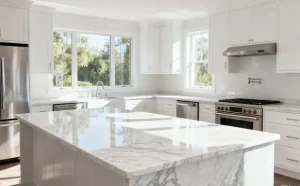
Choosing the right marble starts with the use case. Is the stone for a façade lobby wall, flooring, vanity tops, or a signature countertop? Is it for a hotel, residential tower, civic space, or commercial plaza? The answer changes the right type of marble.
We usually guide buyers through five checkpoints:
Visual target: quiet, dramatic, warm, cool, or iconic
Quantity: how many square meters and how many matching slab lots
Processing: polished, honed, cut-to-size, waterjet, or custom fabrication
Delivery plan: block, full slab, or finished project package
Technical support: drawing review, vein matching, packing, and logistics
This is especially important for contractors and importers. Large jobs need more than pretty samples. They need supply discipline. A good stone partner helps you review blocks, compare lots, manage tolerance, and reduce installation risk before the material ships.
For contractors, wholesalers, and developers, the first question should not be price. It should be: can this supplier support my project from quarry to site? Stone supply is not just a product purchase. It is a delivery chain.
Ask these questions before placing an order:
Which quarry is the material from?
Is the stone quarried in italy or from another source market?
Can I review current slab photos and lot numbers?
How will the supplier manage color range and veining consistency?
Can they produce a full marble slab program and cut-to-size package?
What technical support is included for interior design projects or exterior applications?
How are crates packed, labeled, and scheduled?
As a professional stone manufacturer and supplier, we see this every day: the best buyers think long-term. They want reliable output, fast replies, custom fabrication, and real support after the PO. That is exactly why long-term supply partnerships matter more than one-time spot pricing.
A developer planning a premium mixed-use project wanted a luxurious marble look in the lobby, lift hall, and selected restroom areas. At first, the team compared only sample chips. That created confusion because the chips hid lot variation and scale.
We shifted the process to full slab review. Instead of buying stone according to small samples, the buyer reserved grouped slabs by area and matched visual flow before fabrication. The team also separated focal panels from standard wall zones. That simple planning step improved layout quality and helped control waste.
The result was better than a material decision alone. It was a supply decision. The project kept design consistency, delivery stayed on schedule, and the client avoided last-minute replacement work. In our experience, that is how stone supply creates value: not only through the product, but through planning, fabrication, and reliable execution.
Are Carrara, Calacatta, and Statuario the only three marble types?
No. They are the three most famous premium Italian white categories, but many other different marble types exist in global stone supply, including beige, black, green, and brecciated materials.
Which marble is best for countertops?
The best marble for countertops depends on the project style, quantity, and client expectation. Carrara suits broad-use elegance, while Calacatta and Statuario work well when the goal is stronger luxury impact.
Why do some marble slabs look very different from each other?
Because marble is a natural material. Each slab is unique to each variety, and even slabs from the same lot may show differences in tone, movement, and distinctive veining.
Is marble good for large commercial projects?
Yes, when the supply is planned correctly. Large projects need the right quarry source, grading, reserve quantity, fabrication control, and logistics support to keep the visual standard consistent.
What is the difference between white marble and black marble?
The main difference is visual tone and mineral influence. White marble usually creates a brighter, more open feel, while black marble such as Marquina creates stronger contrast and a more dramatic statement.
What should importers focus on before bulk purchase?
Importers should focus on quarry source, lot consistency, slab photos, dimensional tolerance, finishing quality, packaging method, shipping schedule, and supplier support for post-order communication.
The classic 3 marble types are Carrara marble, Calacatta marble, and statuario marble.
These stones differ mainly in background color, rarity, and veining style.
Carrara marble is softer and more versatile.
Calacatta marble is bolder and more dramatic.
Statuario marble is often the most premium and exclusive-looking.
The right marble type depends on project image, quantity, layout, and supply control.
Large buyers should evaluate quarry source, slab matching, fabrication ability, and delivery support, not just unit price.
For contractors, developers, importers, and wholesalers, a reliable stone partner helps turn design intent into smooth project execution.

 English
  French
  German
  Russian
  Arabic
