Avoid your inquiry is delay response, please enter your WhatsApp/Skype along with the message, so we can contact you at the very first time.
We will reply you within 24 hours. If for urgent case, please add WhatsApp/WeChat: +8615063007107,. Or call 0086-15063007107 directly.
Choosing the wrong floor can lead to chips, stains, slippery surfaces, and costly replacements. That risk grows fast in busy homes and commercial projects. The good news is simple: when you match the right granite tile finish, thickness, and installation method to the space, granite becomes a strong long-term flooring option.
Yes, granite tile is good for flooring. Granite is widely used on floors because it is hard, abrasion-resistant, durable, and available in many colors and finishes. The best results come when you choose the right texture, use proper slip resistance planning, and work with a reliable stone supplier for quality, fabrication, and professional installation.

Is granite a smart flooring choice for homes and commercial settings?
What makes granite tile different from marble, porcelain, and ceramic tiles?
What are the pros of granite floor tile?
What are the pros and cons of granite in a bathroom or wet floor area?
Polished granite or honed granite: which texture works better?
Granite tile or granite slabs: which one fits your flooring project?
Is granite tile slippery, and how can you improve slip resistance?
How do you clean, seal, and maintain granite flooring?
Is granite tile good for heavy foot traffic and commercial space use?
How do you choose a granite supplier and install granite correctly?
From a stone supplier’s view, granite is one of the safest long-term choices for a floor when the project needs strength, visual value, and reliable performance. The Natural Stone Institute says granite has long been used in pavement, curbs, and other heavily used surfaces because of its strength, abrasion resistance, and weathering durability. It also describes granite as an excellent choice for floors and other heavily used surfaces.
That matters in both residential and commercial settings. A homeowner may focus on appearance, cleanup, and resale value. A contractor or project developer usually looks deeper: durability, finish consistency, labor costs, replacement risk, and long-term maintenance. For both groups, granite flooring stands out because it delivers beauty and durability at the same time.
I would describe granite as a popular flooring choice because it can work across villas, lobbies, corridors, stairs, retail zones, and selected outdoor spaces. It is also a practical flooring choice for buyers who want a material that can handle temperature changes, daily wear, and a wide range of design styles without going out of date quickly.
At its core, granite is a coarse-grained intrusive igneous rock. The U.S. Geological Survey explains that intrusive igneous rock forms when magma is trapped deep inside the Earth and cools slowly, which is why granite develops a coarse-grained texture. That geological origin helps explain why granite is so dense and strong as a floor material.
Compared with marble, granite usually feels tougher and more work-ready in busy areas. Marble offers soft movement and elegant veining, but many buyers choose granite when they want a harder-wearing flooring option with a more practical balance between appearance and performance. Compared with porcelain and ceramic tiles, granite brings the character of natural stone, deeper mineral variation, and a more premium material story. Porcelain tiles can be more uniform and easier to source in exact repeats, while granite gives you a more natural visual result.
The choice often comes down to what the project values most. If you want factory-controlled uniformity, porcelain tiles or ceramic tiles may fit. If you want a natural material with a classic appearance, strong scratch resistance, and a surface that can last a lifetime, granite tile flooring becomes much more attractive.
The biggest benefits of granite start with strength. The Natural Stone Institute notes granite’s hardness, abrasion resistance, and superior weathering durability. It also says granite’s mineral hardness gives it excellent scratch resistance and that it is suited to floors and other heavily used surfaces. For a floor that must handle carts, luggage, chairs, and daily wear, that matters a lot.
Another key benefit is moisture behavior. The Natural Stone Institute says granite generally has very low absorption rates and may be treated with impregnating repellents to further improve stain resistance. That does not mean every granite tile is stain proof, but it does mean properly selected and maintained granite is usually more reliable than many softer materials in active environments.
For design, granite gives you a variety of styles. You can choose pale tones for a bright floor, warm golden material for a welcoming lobby, or black granite for a bold commercial look. On Taide’s site, the visible product groups include golden granite finishes, white granite options, sesame black granite stone, and red granite products. The company’s product center also shows a broad granite catalog, which is useful for buyers comparing granite tiles for flooring or other architectural uses.

A bathroom is where buyers usually ask the most practical question: is granite safe and smart on a wet floor? The answer is yes, but finish matters. Granite can be quite resistant to moisture when correctly selected and maintained, and Natural Stone Institute care guidance explains that sealing is often used as an extra precaution against stain absorption. Still, the same guidance makes clear that sealing does not make stone stain proof. It simply makes it more resistant to staining.
The main caution is slipperiness. A highly reflective polished granite tile may look beautiful, but it can become slippery when wet. In fact, any floor with inadequate slip resistance increases the risk of slipping accidents, which is exactly why the Natural Stone Institute’s ASTM guidance stresses testing and matching stone to the application. In wet rooms, the goal is a better balance between slip resistance and ease of cleaning, not just maximum shine.
So yes, granite is an excellent choice for a bathroom when you pick the right finish. But if the question is whether a high-gloss surface is always best, the answer is no. In wet areas, some polished surfaces can feel extremely slippery when wet, so many designers lean toward a softer honed granite or textured finish instead.
This is one of the most important finish decisions in any flooring project. A polished granite finish gives a reflective, high-gloss look that many buyers love for grand entries and formal interiors. It can make color look richer, help the tile reflect light, and support a very clean visual style. For showpiece lobbies and premium residential interiors, that polished floor can be stunning.
A honed granite finish is different. Instead of a glossy shine, it gives a softer matte look. In practical terms, that often helps when the project needs a slightly calmer appearance or improved footing. If the space includes a bathroom, service entry, or a corridor where moisture may appear, a honed finish is often better for flooring than an aggressively glossy surface. The keyword here is texture. Finish changes how the tile feels, looks, and performs.
From my side, I usually say this:
| Finish | Best for | Main visual effect | Main caution |
|---|---|---|---|
| Polished granite | Luxury interiors, lobbies, statement areas | Rich color, reflective, formal | Can be more slippery in wet conditions |
| Honed granite | Wet areas, calmer interiors, practical circulation zones | Soft matte finish | Less shine than polished stone |
| Textured finish | Exterior paving, some commercial entries, selected outdoor spaces | Strong grip, practical surface | More cleaning attention may be needed |
That is why the right finish is not only about style. It is about how the floor will actually be used.
The Natural Stone Institute design manual defines tile as a thin, flat piece of stone used as finishing material, while cut-to-size pieces derived from slab stock are fabricated to project dimensions. In simple terms, standard granite tile is good when you want repeatable module sizes and more straightforward installation planning. Cut pieces from granite slabs are better when you want custom sizing, fewer joints, or a more premium bespoke result.
For a mid-size residential floor, a granite floor tile format may be enough. It controls budget and simplifies layout. For a landmark lobby or high-end commercial reception, cut pieces from granite slabs can reduce visible joints and give the floor a more continuous look. That is one reason many large projects compare both options before finalizing the square foot layout and finish schedule.
A simple rule works well here. Use standard flooring tiles when speed and modularity matter. Use slab-based custom fabrication when the design demands a custom grid, tighter detailing, or large-format presence. Buyers often compare material per square foot, but they should also compare processing, breakage risk, and labor costs. A cheap tile can become expensive if the layout is inefficient.
Granite can be slippery, but that depends far more on the finish and context than on the word “granite” alone. The Natural Stone Institute states clearly that interior or exterior flooring with inadequate slip resistance is more likely to cause slipping accidents. That means buyers should evaluate finish, location, drainage, cleaning method, and real traffic conditions rather than relying on visual preference alone.
There are several practical ways to reduce risk:
Natural Stone Institute care guidance also recommends mats or rugs at entrances to reduce sand and grit, and it notes that the underside of mats should be slip resistant. That small detail helps both safety and surface protection. So yes, the pros and cons of granite include slip concerns, but good design and maintenance decisions solve much of that risk.
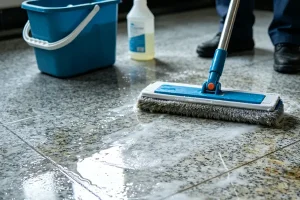
One reason granite remains a strong flooring option is that it can be easy to maintain when the care plan is right. The Natural Stone Institute recommends dust mopping stone floors frequently and cleaning with a neutral cleaner, stone soap, or mild liquid dishwashing detergent and warm water. It also warns against products containing lemon, vinegar, or other acidic ingredients because they can damage some stones or dull surfaces.
Yes. This is where granite really earns its reputation. The Natural Stone Institute’s ASTM overview specifically notes the relevance of abrasion resistance, absorption, compressive strength, bending strength, and slip resistance when stone is used for interior commercial flooring. It even gives examples involving pedestrian traffic and cleaning carts. That is exactly why granite tile is a strong choice for high-traffic use.
In a hotel lobby, transit corridor, retail hall, or office reception, the floor must handle repetitive wear without looking tired too fast. Granite’s hardness and abrasion resistance make it a smart option for these commercial settings. When buyers ask me about long-lasting flooring for a commercial space, granite is usually near the top of the list, especially when the traffic pattern is predictable and the finish has been chosen carefully.
It is also useful beyond floors alone. Many projects use matching granite on walls and floors, stair treads, thresholds, or even feature walls to create a more complete stone language across the building. That continuity is hard to achieve with cheaper materials that vary too much from batch to batch.
Even the best granite stone tiles can fail if the sourcing and installation plan is weak. The Natural Stone Institute design guidance strongly recommends qualified stone engineering and accredited installation support in appropriate projects. That is especially important when you need custom sizes, special edges, or large public flooring applications. Professional installation is not a luxury in those jobs. It is risk control.
For sourcing, I would look at four things first: material availability, fabrication ability, finish consistency, and response speed. Taide’s public site says the company was founded in 2001 and has multiple production bases and a large product center of granite categories, which helps support its positioning as a long-term stone manufacturer and supplier. If a buyer wants to review production background and catalog structure, the most natural internal links are our stone manufacturing capabilities, the granite product center, and the finish-specific product groups already mentioned above.
When you install granite, do not choose by price alone. A sound flooring project should review thickness, backing condition, joint layout, finish, traffic, cleaning method, and expected moisture exposure. That is how you turn granite tiles for flooring from a nice material into a dependable asset.
| Material | Strength for floor use | Moisture behavior | Visual style | Main caution |
|---|---|---|---|---|
| Granite | Very high | Good when properly maintained | Natural, rich, premium | Finish selection affects slip risk |
| Marble | Moderate to high | More sensitive to staining and etching | Elegant, soft veining | Softer than granite in many uses |
| Porcelain | High | Very good | Uniform, repeatable | Less natural stone character |
| Ceramic tiles | Moderate | Good in many interiors | Wide style range | Usually less premium than granite |
Granite remains a strong answer when the buyer wants low maintenance, premium appearance, and a material that can last a lifetime with correct use and care.
Is granite tile good for flooring in a home?
Yes. Granite tile is good for a home floor when the buyer wants strength, long life, and a premium finish. It is especially useful in entries, living zones, corridors, and other spaces where durability matters.
Is granite better than marble for flooring?
For many high-use floors, granite is often chosen over marble because it is generally harder-wearing and less vulnerable to everyday wear. Marble is still beautiful, but granite is often preferred where the surface must work harder.
Are granite tiles for flooring slippery?
They can be, especially if the finish is highly polished and the floor gets wet. That is why finish and slip resistance testing matter. Wet areas often benefit from a honed or textured finish instead of maximum gloss.
Do granite floors need sealing?
Sometimes. The Natural Stone Institute says sealing is a common extra precaution for some stones, but it does not make the stone stain proof. The right schedule depends on the stone and the supplier’s recommendation.
Is granite a good flooring option for commercial settings?
Yes. Granite is widely used in commercial flooring because of its abrasion resistance and long-term durability. It is a strong option for public interiors with steady use.
What are the main pros and cons of granite flooring?
The main pros are strength, design value, long service life, and low day-to-day maintenance. The main cons are higher upfront cost, the need for correct finish selection, and the fact that some polished surfaces may be too slippery in wet conditions.
Granite tile is good for flooring when the finish, installation, and maintenance plan match the space.
Granite is valued for durability, abrasion resistance, and long service life.
A glossy polished granite surface can look beautiful, but it may be too slippery when wet for some uses.
Honed granite often gives a better safety-performance balance in wet or practical zones.
Granite works well in both homes and commercial settings, especially where there is heavy foot traffic.
The right tile format, slab option, and finish can change the success of the whole flooring project.
Proper cleaning, mats, and the right sealing plan help keep granite easy to maintain.
For bulk supply and custom fabrication, the supplier matters just as much as the stone.
If the goal is long-lasting flooring with a premium look, granite remains one of the strongest options available.

 English
  French
  German
  Russian
  Arabic
