Avoid your inquiry is delay response, please enter your WhatsApp/Skype along with the message, so we can contact you at the very first time.
We will reply you within 24 hours. If for urgent case, please add WhatsApp/WeChat: +8615063007107,. Or call 0086-15063007107 directly.
Bad news: many projects lose time and money because a retaining wall fails early—cracks, leaning, bulging, or drainage blowouts. That’s painful for contractors, developers, and property owners. Good news: when you choose the right retaining wall materials and build with proper drainage, a wall can last for decades with low maintenance.
Most landscape block retaining wall systems last 40–75+ years when properly built and maintained, while timber often lasts 15–30 years, depending on environmental conditions and drainage. Natural stone and well-designed concrete systems can reach 75–100 years in long-term applications.
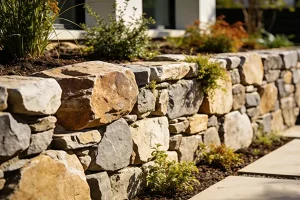
landscape block retaining wall
What is the average lifespan of a retaining wall?
Which types of retaining wall last the longest?
Concrete block vs natural stone vs timber: how do walls last over time?
What key factors that affect retaining wall longevity behind the wall?
Why drainage decides whether a retaining wall lasts or fails early
How erosion and soil erosion shorten the lifespan of retaining walls
Do poured concrete walls last longer than block walls?
How to extend its lifespan with regular maintenance and smart inspections
Case study: choosing the right retaining wall materials for a large landscape project
Buying guide + FAQs: selecting long-lasting landscape blocks for contractors and importers
If you want a simple number: the average lifespan of a retaining wall depends on the materials used, how well it’s built, and what’s happening behind the wall. In many real-world installs, block retaining walls often land in a 40–75 year range when the base and drainage are right, and some engineered systems can be designed for longer service life targets (like 75 years) in critical applications.
Here’s the practical way I explain it to buyers: you are not “buying blocks.” You are buying structural support—a system meant to hold back soil, manage water, and keep structural integrity through seasons, freeze-thaw, and heavy loads. When contractors plan for water and base conditions, a wall can last for decades and endure the test of time.
Quick reality check: a retaining wall lasts longer when it is designed like infrastructure, not like decoration. That’s true for residential and commercial work—and even more true for municipal landscaping and construction.
Different types of retaining walls behave differently. In general, natural stone and well-designed concrete systems are known for long service life, while timber retaining walls typically have a shorter lifespan due to rot risk and moisture. Sources often describe a broad range—from about 15 years to 100+ years—depending on design and build quality.
A simple ranking (typical outcomes, not a promise):
Natural stone retaining walls: often described as long-lasting and capable of very long service life when properly built and drained.
Concrete masonry unit / segmental systems (SRW): frequently engineered for long-term applications and can be designed around long design lives in infrastructure settings.
Poured concrete walls: strong and durable, but cracks and poor drainage can shorten the wall’s lifespan.
Timber walls / wooden retaining walls: commonly cited in the 15–30 year range (sometimes more with excellent conditions and upkeep), but moisture and insects are constant threats.
As a professional stone manufacturer and supplier, I like to be direct: if the project is large-scale, public-facing, or hard to repair later, choosing the right material early is cheaper than rebuilding later.
Let’s compare the main options in a way contractors and importers can use for fast decisions.
| Retaining wall materials | Typical lifespan | What helps it last a long time | Common risk |
|---|---|---|---|
| Concrete block (segmental / interlocking) | 40–75+ years | proper base + proper drainage + good backfill | water pressure, poor compaction |
| Natural stone | 40–100+ years (often cited) | durable stone, correct structure, good drainage | weak joints, poor base |
| Timber | ~15–30 years (common citations) | treated wood, dry conditions, routine maintenance | rot, insects, moisture |
Concrete block systems are popular because of ease of installation, repeatability, and predictable geometry. That’s why you see them everywhere in landscape work. Natural stone wins when buyers want premium appearance plus long-term durability—especially in commercial property development and civic spaces.
Timber can be attractive upfront and sometimes cheaper, but it is more sensitive to environmental conditions and moisture. If the wall sits in wet soil, timber walls often age fast.
Most retaining wall failures start behind the wall. That’s the part many bids under-scope—and where I see the biggest avoidable mistakes.
Here are the key factors that affect longevity of a retaining wall:
Drainage design (the #1 issue)
quality of base, leveling pad, and compaction
correct backfill material and placement
slope loading and surcharge (cars, equipment, structures)
environmental conditions (freeze-thaw, heavy rain, salt exposure)
soil type and water movement
If you remember one line, make it this:
“A retaining wall isn’t fighting soil. It’s fighting water pressure.”
When water builds up, the wall can lean, bulge, or lose structural integrity. That’s when you see a retaining wall failure—often suddenly after storms.
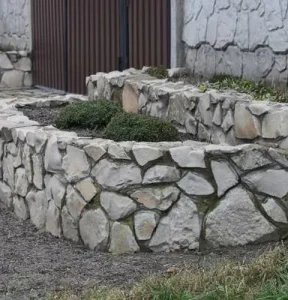
Baipo Yellow Wall Stone
I’m going to say drainage a lot because it deserves it. Without proper drainage, even high-quality stone and concrete can fail.
A good plan usually includes (depending on wall type and site):
drainage aggregate zone (free-draining stone behind the wall)
geotextile separation (to reduce clogging)
weep outlets or collector drains (where appropriate)
correct grading so surface water moves away
In segmental systems, best-practice guides emphasize inspection, soil properties, and design/installation practices that keep the system stable over time.
Simple “water test”: If you imagine a heavy rain, where does water go? If the answer is “into the wall,” your wall’s lifespan drops fast.
Erosion and soil erosion attack the wall in two ways:
They remove support at the base and toe
They move fines into drainage zones, clogging the system
When that happens, water pressure rises, and the wall loses stability and longevity. This is why landscapers often see failures after big storms: the soil moved, the drainage got overwhelmed, and the wall shifted.
If you’re working in harsh environmental conditions—coastal salt, freeze-thaw cycles, or heavy seasonal rainfall—plan for stronger drainage and more conservative design. It’s boring work, but it keeps walls last for years—and sometimes last for decades.
This is a common question in procurement: poured concrete walls vs block systems.
In many guides and contractor resources, poured concrete walls are described as strong and often 50+ years, while concrete block walls can also reach long service life when built correctly and maintained.
My practical take:
Use poured concrete walls when you need a monolithic structure, tight geometry, or very specific structural demands.
Use block walls (segmental / interlocking) when you want flexible construction staging, easier repair, and predictable unit-based installation.
Either way, the same truth applies: proper drainage and correct backfill decide how long a retaining wall lasts.
You don’t need a complicated plan to extend service life. You need a consistent one.
Regular maintenance checklist (simple, effective):
Inspect after major storms
Look for bulging, leaning, cracked caps, or separated joints
Confirm downspouts and surface runoff do not dump behind the wall
Clear weep paths (if present)
Watch vegetation roots near the wall
A wall can last a long time when it’s properly built and maintained. That’s not marketing—it’s engineering common sense.
Drainage design quality: ██████████ (most important)
Base/compaction quality: █████████
Material durability (stone vs timber): ███████
Environmental conditions: ██████
Maintenance discipline: █████
If you want a low maintenance solution, natural stone and well-made concrete systems tend to outperform timber in most climates.
Project type: commercial property development + streetscape landscaping and construction
Buyer: contractor + developer team (bulk procurement needs)
Goal: long-lasting wall appearance, fast delivery, stable performance
Constraint: mixed soil + heavy rain season → drainage critical
What we recommended (as a stone manufacturer and supplier):
natural stone facing / stone retaining walls for premium public areas
engineered block system in service zones for ease of installation
standardized pallets and QC labeling for faster site handling
project-specific packaging plan to reduce breakage and speed unloading
Result (typical outcome):
improved stability and longevity of a retaining wall because drainage and backfill were specified clearly
fewer on-site surprises because materials used were consistent lot-to-lot
faster installation rhythm (contractors love repeatable units)
That’s the B2B difference: a reliable partner helps you reduce schedule risk, not just supply stone.
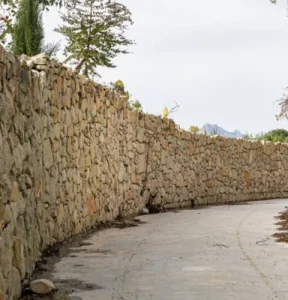
Baipo Yellow Wall Stone
If you’re sourcing for bulk projects, focus on these procurement questions:
Wall type: gravity, reinforced, terraced, or tall wall (type of retaining wall)
Design height and loads (vehicles? fences? structures?)
Drainage details and backfill spec
Finish and texture requirements (natural stone aesthetics vs block system uniformity)
Delivery schedule and packaging needs (crane unload? forklift? site storage?)
bulk volume capacity + stable production scheduling
custom fabrication (cuts, copings, caps, corners)
consistent color range control for large runs
technical support for contractors and project developers
Now the FAQs:
How long do landscape blocks last in a retaining wall?
In many typical installs, concrete block retaining walls can last decades, often cited around 40–75+ years when correctly built and drained.
How long retaining walls last when made from natural stone?
Natural stone walls are widely described as very durable, with sources often citing 40–100+ years depending on build quality and drainage.
Do timber retaining walls last as long as stone or concrete?
Usually not. Timber retaining walls are commonly cited around 15–30 years (sometimes more with excellent conditions and upkeep), but moisture and rot are ongoing risks.
What causes retaining wall failure most often?
Poor drainage and water pressure behind the wall are major drivers, often combined with poor base preparation or clogged backfill zones.
Can retaining walls can last 75–100 years?
Yes in many engineered, critical applications where design life targets like 75–100 years are used (especially with reinforced systems and proper design assumptions).
What’s the best way to extend its lifespan without rebuilding?
Keep water away: manage surface runoff, protect drainage paths, and do regular inspections after storms. Small fixes early prevent expensive structural repair later.
A retaining wall lifespan depends more on drainage and base work than on block appearance.
Concrete block systems often deliver long service life when properly built; natural stone is widely cited as long-lasting and premium.
Timber is usually shorter-lived because moisture, rot, and insects reduce durability.
Erosion and clogged backfill reduce stability and can trigger retaining wall failure.
For large projects, choose a supplier who supports bulk delivery, consistent quality, and technical guidance—not just materials.

 English
  French
  German
  Russian
  Arabic
